Your EV’s range estimate looked fine when you left the house. Then came the I-8 grade, the AC, the stop-and-go through El Cajon — and now you’re watching the battery tick toward zero somewhere between La Mesa Boulevard and the Grossmont off-ramp. It happens to San Diego drivers every week, and La Mesa’s geography makes it more likely than you’d expect.
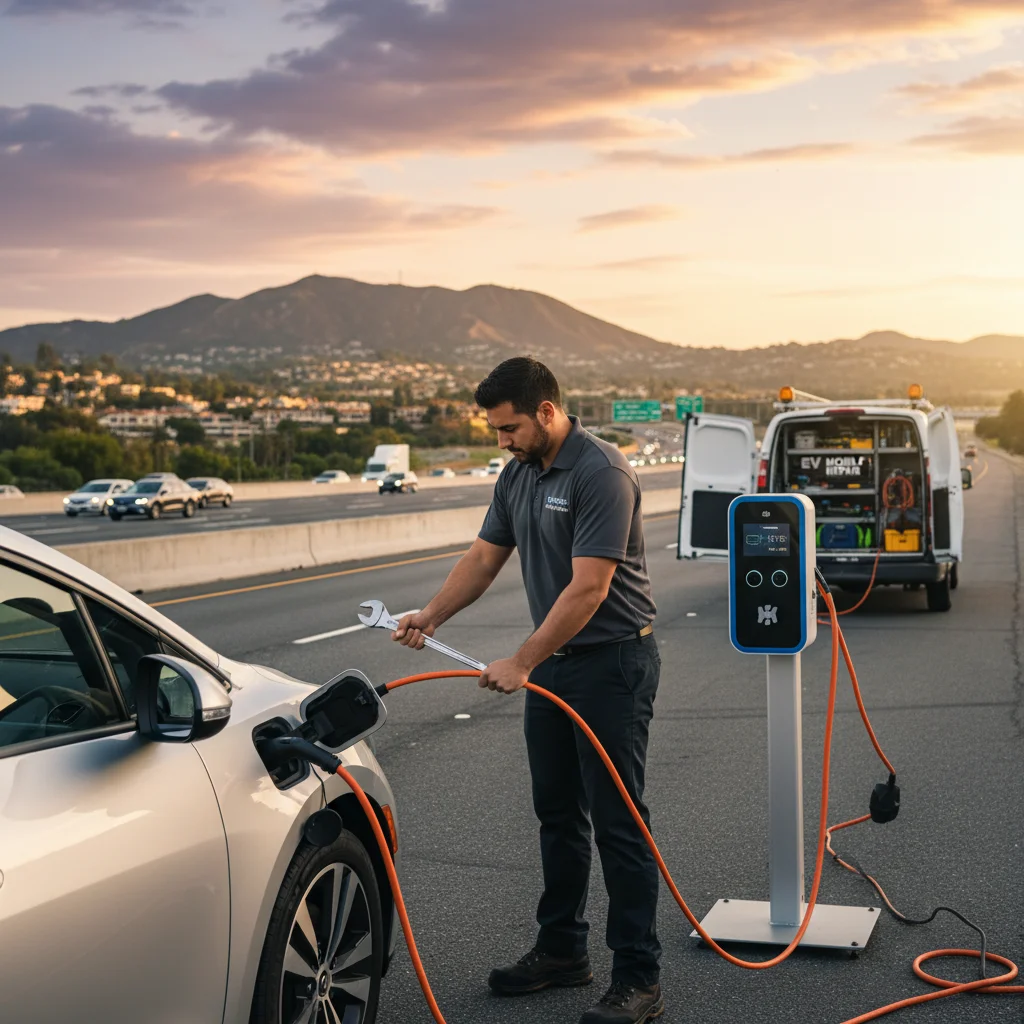
Where La Mesa EV drivers run out of charge
La Mesa sits at the hinge between coastal San Diego and East County. That position means a lot of through-traffic — commuters heading home from downtown, shoppers swinging through Grossmont Center, and residents climbing the residential streets that roll up toward Mount Helix. Each of those patterns creates a distinct way to strand an EV.
The flatland sections around La Mesa Village are forgiving. You’ve got surface streets, easy pullouts, and decent public charging at a handful of locations near Spring Street. But the moment you start climbing — toward Helix, toward the neighborhoods east of SR-125, or up the Severin Drive hill — the math changes fast. Cold-pack regeneration is weaker in San Diego’s mild climate than in northern states, and drivers don’t always account for that.
The other common trap is deferred charging. La Mesa has a high density of single-family homes, and a lot of EV owners rely on a Level 1 outlet in their garage. If that outlet has been slow-charging a car that’s been driven more than usual, Tuesday night’s commute can leave the battery lower than expected by Wednesday morning. Add a detour, a last-minute errand, and a stop on a hill — and you’ve got a stranded EV before noon.
Our mobile EV charging service covers all of La Mesa, including the quieter residential pockets that general roadside services sometimes underestimate. We know this city’s topography, and we plan our routes accordingly.
I-8 and SR-125 stranded-EV patterns
Interstate 8 through La Mesa is one of San Diego County’s busiest EV corridors. Drivers coming from Mission Valley or heading toward El Cajon are often already running lower than they realize by the time they hit the city limits. The uphill grade between the 70th Street interchange and the Grossmont/SR-125 split is short but steep — enough to pull an extra 10-15% from a pack that’s already in the red.
SR-125 adds another wrinkle. The stretch between I-8 and the Grossmont Center area has limited shoulder space and fast-moving traffic. If you lose propulsion there, you need help that arrives quickly and doesn’t require a flatbed to maneuver in a tight spot. Tow trucks struggle on that corridor. A mobile charging unit doesn’t.
When you’re stopped on a freeway shoulder anywhere in La Mesa, the first call is 911 if you’re in a dangerous position — then our EV roadside assistance line. We’ll get your location from you, confirm which highway and direction, and dispatch from the nearest point. Our Cybertruck rescue trucks are built to operate in high-visibility freeway conditions and carry enough stored energy to push most EVs 20-40 miles — enough to reach the nearest DC fast charger.
For more on what to do the moment you realize you’re running out on a freeway, our guide on running out of charge on a San Diego freeway is worth reading before it happens to you.
Grossmont Center and the climb to Mount Helix
Grossmont Center is the biggest retail anchor in East County, and it draws EV drivers from across La Mesa, El Cajon, and Santee. The parking lot has public charging stations, but they’re frequently occupied, occasionally offline, and not always visible if you’re unfamiliar with the layout. Drivers who pull in already low — planning to top off while they shop — sometimes find every stall taken and leave without the charge they needed.
The climb to Mount Helix is a different kind of problem. The residential streets up there — Grossmont Summit Drive, Helix View Drive, and the switchbacks around the peak — are steep, winding, and narrow. Drivers exploring the area or visiting friends can lose 15-20% battery just getting up there, and come back down without enough range to reach a charger. If you’re parked on a hillside street with a dead pack and no flat spot to wait, a mobile rescue team is the only practical solution. A tow truck on those streets is a slow, expensive ordeal.
We’ve also seen stranded EVs on the streets connecting La Mesa Village to the lower Mount Helix neighborhood — Spring Street to Nebo Drive and beyond. The elevation change is gradual but persistent, and it catches drivers who underestimate it on the way back from a Village coffee run.
If you’re driving over to El Cajon after La Mesa, note that we cover that city too — the El Cajon EV roadside guide has area-specific details worth bookmarking.
What we bring and how fast we arrive
Our Cybertruck rescue trucks carry a portable DC charging unit capable of delivering 20-40 miles of range in 20-30 minutes depending on your vehicle’s onboard charger. That’s enough to get a stranded Tesla, Ford Mach-E, Chevy Blazer EV, Rivian, or Hyundai Ioniq off the shoulder and to a full charging session nearby.
We also carry jump capability for 12V auxiliary battery failures — a separate but common breakdown that can lock you out of your vehicle entirely. If your EV won’t power on at all and the high-voltage pack is fine, a dead 12V is usually the culprit. It’s one of the most underappreciated failure modes in EVs, and it’s not the same as running out of range. The 12V battery failure symptoms post goes deeper if you want to understand what to watch for.
Response times for La Mesa depend on traffic and time of day. On a typical weekday afternoon, we can reach most La Mesa locations within 30-45 minutes. I-8 and SR-125 shoulders during peak hours can run longer if CHP has restricted access, but we’re in contact with you throughout. You’ll know when we’re coming and when we’re close.
We serve all vehicle brands. Tesla drivers have a few model-specific quirks we know well, but we handle Ioniq 5s, Mach-Es, Rivian R1Ts, Chevy Equinox EVs, and anything else running on a lithium pack. If you’re not sure whether we can help your vehicle, call us — the answer is almost always yes.
Mobile charge vs tow for East County drivers
A tow is the right call in specific situations: collision damage, a failed drive unit, a high-voltage pack fault that won’t clear. But for the most common La Mesa breakdown — an empty battery — a tow adds cost and time without solving the underlying problem. You still need to charge the car. A tow just relocates the empty car to a parking lot near a charger, and then you wait anyway.
Mobile charging resolves the situation in place. We drive to you, plug in, and give you enough range to reach a Level 2 or DC fast charger on your own. You’re back on the road faster, and the bill is smaller. Most La Mesa calls don’t require a flatbed.
The exception worth planning for: if you’re stranded on I-8 during a Sig Alert or in a spot where it’s unsafe to wait, a quick tow to a legal parking area followed by mobile charging can be the right sequence. We can coordinate that if needed. But nine times out of ten, mobile charging alone handles it. Our mobile charging vs tow comparison breaks down the scenarios if you want the full picture.
For drivers wondering about costs, how much mobile EV charging costs gives real numbers without the runaround.
The US Department of Energy’s AFDC tool can show you permanent charging locations near La Mesa if you want to map out a regular charging routine and avoid the emergency call altogether.
When to call Charge Pro
If you’re stranded in La Mesa with a dead pack, a 12V failure that’s locked you out, or a range emergency on I-8 or SR-125 — that’s our call to take. We don’t do installs; we do rescues, and that’s what we’re built for. Call us at (858) 808-6055 — we’ll roll a Cybertruck rescue truck to you.