Running low on charge in El Cajon is a different kind of stressful. You’re not near a Tesla Supercharger on the 5, and the nearest public fast charger might already have a line. One wrong turn on the way home from Parkway Plaza and you’re watching your range estimate collapse on the dash.
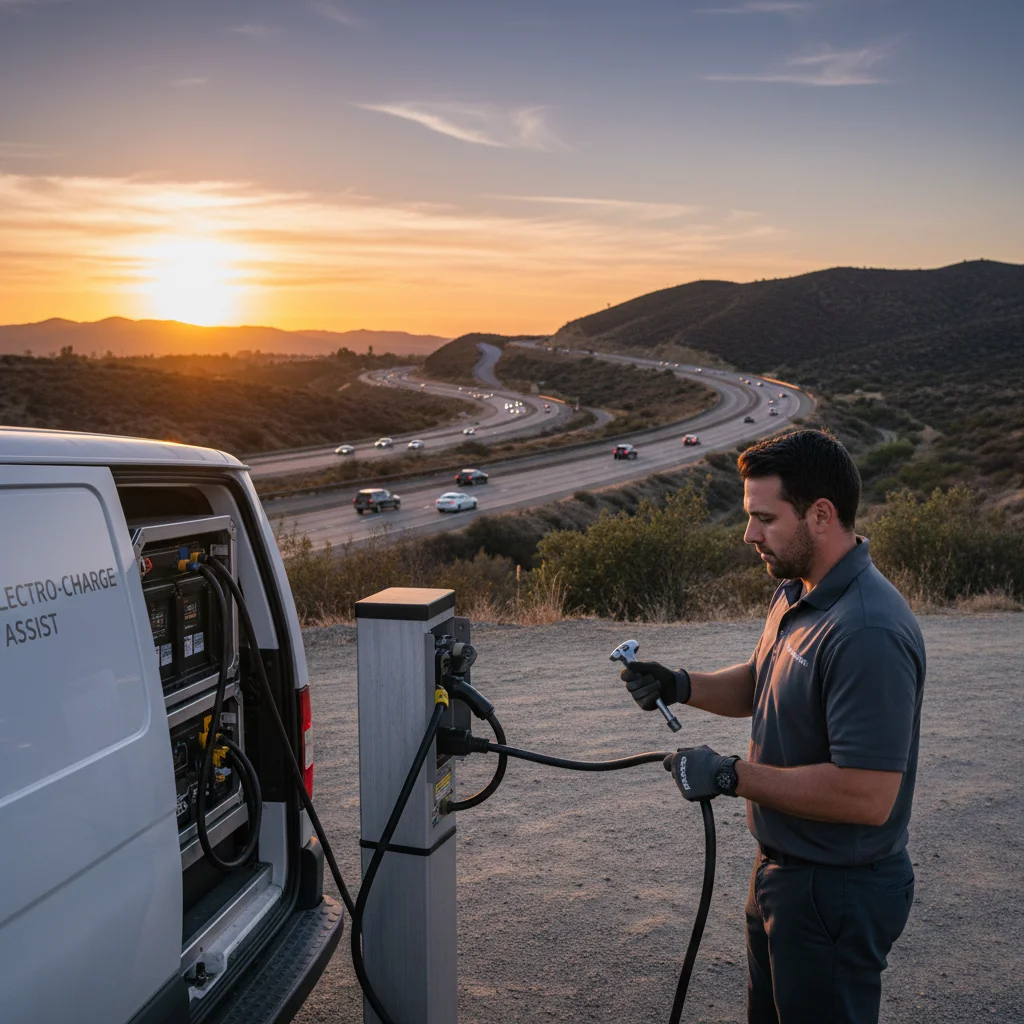
Where El Cajon EV drivers run out of charge
El Cajon sits at the edge of what EV drivers privately call the East County gap — a stretch of San Diego County where public DC fast chargers thin out fast. The Parkway Plaza area on Fletcher Parkway has some Level 2 options, but they’re slow and often occupied. Gillespie Field on Cuyamaca Street draws pilots, aviation workers, and nearby business commuters who park for hours, sometimes returning to a charger that never actually started.
The city’s geography doesn’t help. El Cajon sits in a valley, but the roads climbing out of it — toward Granite Hills, Crest, and the Cuyamaca foothills — are steep enough to pull 15-25% more energy from your pack than flat-road estimates suggest. Drivers who leave El Cajon with what looks like comfortable range can find themselves short before they’ve crested the hill.
Then there’s the return trip. Commuters driving back from downtown San Diego on I-8 sometimes arrive in El Cajon thinking they’ll charge at home, only to realize they underestimated the final miles. A driveway charger that was unplugged by a family member, a EVSE that tripped a breaker, or just a longer-than-expected day — and suddenly the garage charge never happened.
Our mobile EV charging service was built for exactly this pattern: drivers who made reasonable decisions and still ended up short, in a city that doesn’t have a Supercharger on every corner.
I-8 and SR-67 stranded-EV hotspots
Two highways define El Cajon’s EV rescue geography, and they create very different breakdown scenarios.
I-8 eastbound is the bigger problem. The freeway climbs steadily from El Cajon toward Alpine, gaining roughly 2,000 feet of elevation in about 12 miles. That grade pulls hard on any EV, especially in warm weather when the pack is already warm from a full day’s use. Drivers who check range in El Cajon and see “plenty” can be caught short on the shoulder before the Alpine exit. It’s one of the more common EV breakdown situations in East County — and one of the more exposed places to wait.
SR-67 northbound runs from El Cajon up through Santee and into the mountains toward Ramona. The grades aren’t as punishing as the I-8 climb to Alpine, but SR-67 is a two-lane highway for much of its length north of Santee, with limited shoulders and no easy pull-off spots. Drivers who underestimate the elevation gain between El Cajon and Lakeside can find themselves in trouble on a stretch of road where cell service is spotty and passing traffic is fast.
Both highways see enough stranded EVs that Caltrans data from Q1 2026 flagged East County corridors as an emerging assist hotspot. The common thread: drivers who last charged in a coastal or central San Diego zip code, drove east, and didn’t account for the elevation penalty.
What we bring to an El Cajon call
Charge Pro SD runs rescue out of our East County staging location, not from coastal San Diego. That matters for response time, but it also means our technicians know this terrain.
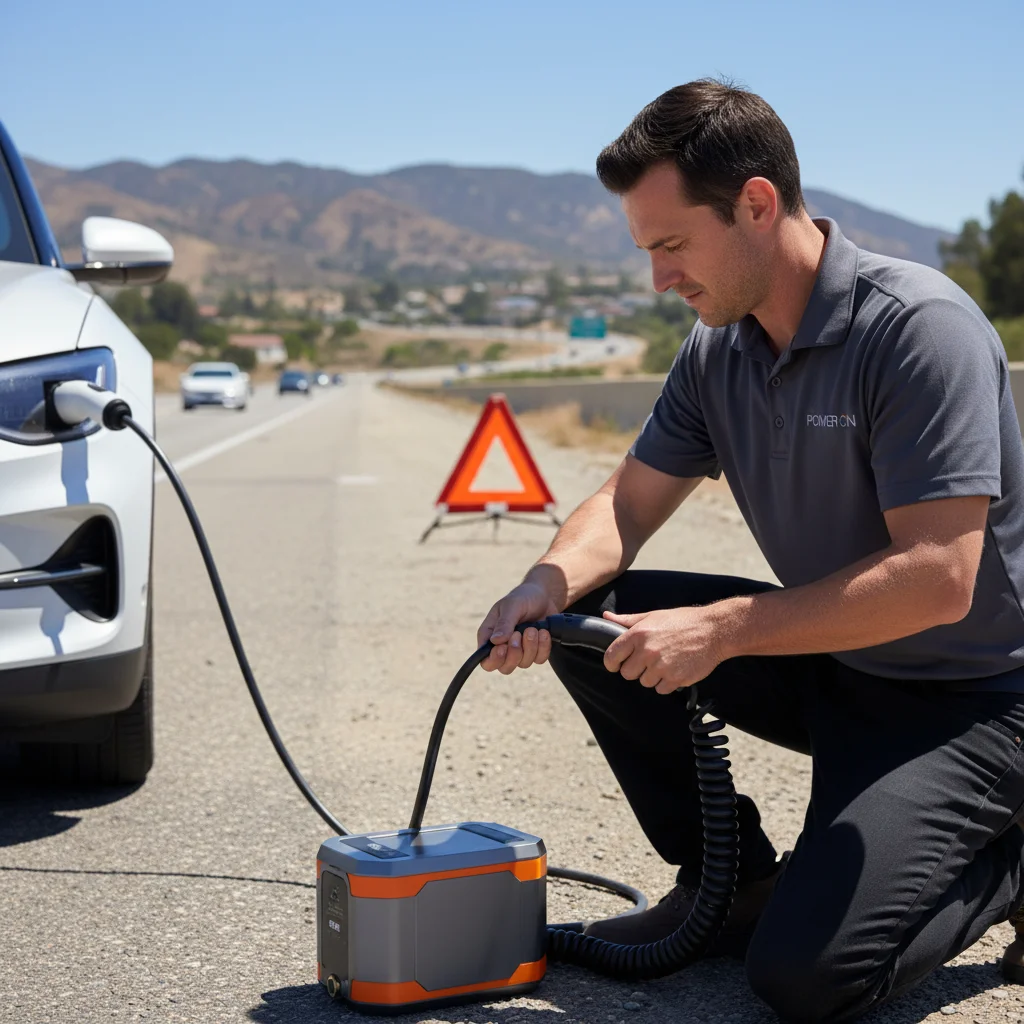
Every call gets a Cybertruck rescue truck carrying a commercial-grade mobile DC fast charger. We support CCS, CHAdeMO, and J1772 — so whether you’re in a Tesla, a Chevy Equinox EV, a Hyundai Ioniq 5, or a Ford F-150 Lightning, we have the connector. Tesla vehicles on the North American Charging Standard (NACS) port are covered too.
Our goal on a rescue call isn’t to fully charge your vehicle — it’s to get you enough range to drive safely to a permanent charger or home. For most El Cajon scenarios, that means delivering 15-30 miles of range in 20-30 minutes. That’s enough to get you off the I-8 shoulder, over the grade, and to a Supercharger in Alpine or back to a home charger in the valley.
We also carry a jump kit for 12V battery failures. On many EVs — Tesla models in particular — a dead 12V auxiliary battery can prevent the car from powering on even when the traction pack is full. If your EV won’t wake up and won’t charge, there’s a real chance it’s the 12V, not the main battery. Our technicians can diagnose and address that on-site. You can read more about what a 12V failure looks like before you call if you want to confirm.
We don’t do charger installation. We’re not electricians, and we’re not going to pull permits. Charge Pro SD is a rescue service — we come to you, we get you moving, and we leave you with enough charge to make the next decision yourself.
Response times from our East County staging
From our East County staging point, typical response to El Cajon is 20-35 minutes depending on where you are and what traffic looks like on I-8 or SR-67.
For calls on the I-8 shoulder east of the 2nd Street exit, we coordinate with Caltrans when needed. If you’re on an active freeway shoulder, stay in your vehicle with hazards on. Call us first, then text your location — we’ll track you and give you an ETA as we roll.
City streets within El Cajon — around Parkway Plaza, Gillespie Field, Main Street, or the residential areas near Granite Hills — tend to run closer to 20 minutes. Granite Hills and Crest, which sit above the valley floor, add 5-10 minutes depending on the exact address.
SR-67 calls north of the I-8 junction are the longest, especially if you’re past Santee and into the mountain stretch toward Lakeside or Ramona. We’ll tell you an honest ETA when you call — no inflated promises.
For context on what other East County and San Diego drivers experience with EV range anxiety and rescue timing, the patterns are consistent: drivers underestimate elevation impact, and East County roads are among the hardest on range in the county.
Mobile charge vs tow for East County drivers
A tow in El Cajon isn’t a fast or cheap option. Most tow companies serving East County will quote 45-90 minutes depending on dispatch availability, and flatbed towing of an EV to a charging-capable destination runs $150-300 or more before you factor in the destination’s charging cost.
Mobile charging is usually faster and almost always cheaper for a straightforward range-depletion rescue. You get charged on-site, you drive yourself to the next destination, and you’re back on your schedule. If your EV has a mechanical issue beyond a dead battery or 12V failure, that’s when a tow makes sense — and we’ll tell you honestly on the phone if what you’re describing sounds like a tow situation rather than a rescue call.
The comparison is worth reading in more detail. Our breakdown of mobile EV charging versus towing covers the decision criteria so you can make the call yourself. The short version: if your car is physically driveable and the problem is charge level or 12V power, call us. If something is mechanically wrong with the drivetrain, wheels, or charge port hardware, a tow shop is the right move.
For East County specifically, the elevation and freeway exposure make a fast mobile rescue more valuable than the regional average. Sitting on an I-8 shoulder while Alpine trucks blow past at 70 mph isn’t a situation you want to extend by an extra hour waiting for a flatbed.
Our emergency EV roadside assistance covers El Cajon, Granite Hills, Crest, Santee, and the I-8 corridor out to Alpine. If you’re not sure whether your location is in our range, call and ask — we’ll tell you straight.
When to call Charge Pro
If your EV is stranded on I-8 or SR-67, sitting dead in a Parkway Plaza parking lot, or refusing to power on in your El Cajon driveway, that’s our call to take. We handle range-depletion rescues, 12V battery failures that leave your car unresponsive, and range emergencies where you need enough charge to get somewhere safe. Call us at (858) 808-6055 — we’ll roll a Cybertruck rescue truck to you.