You plug in at night, come back in the morning, and the CCS cable won’t budge. The Mach-E’s charge port is locked, your commute is ticking, and nothing obvious is wrong. This happens more than Ford would like to admit — and there’s a clear path through it if you know where to look.
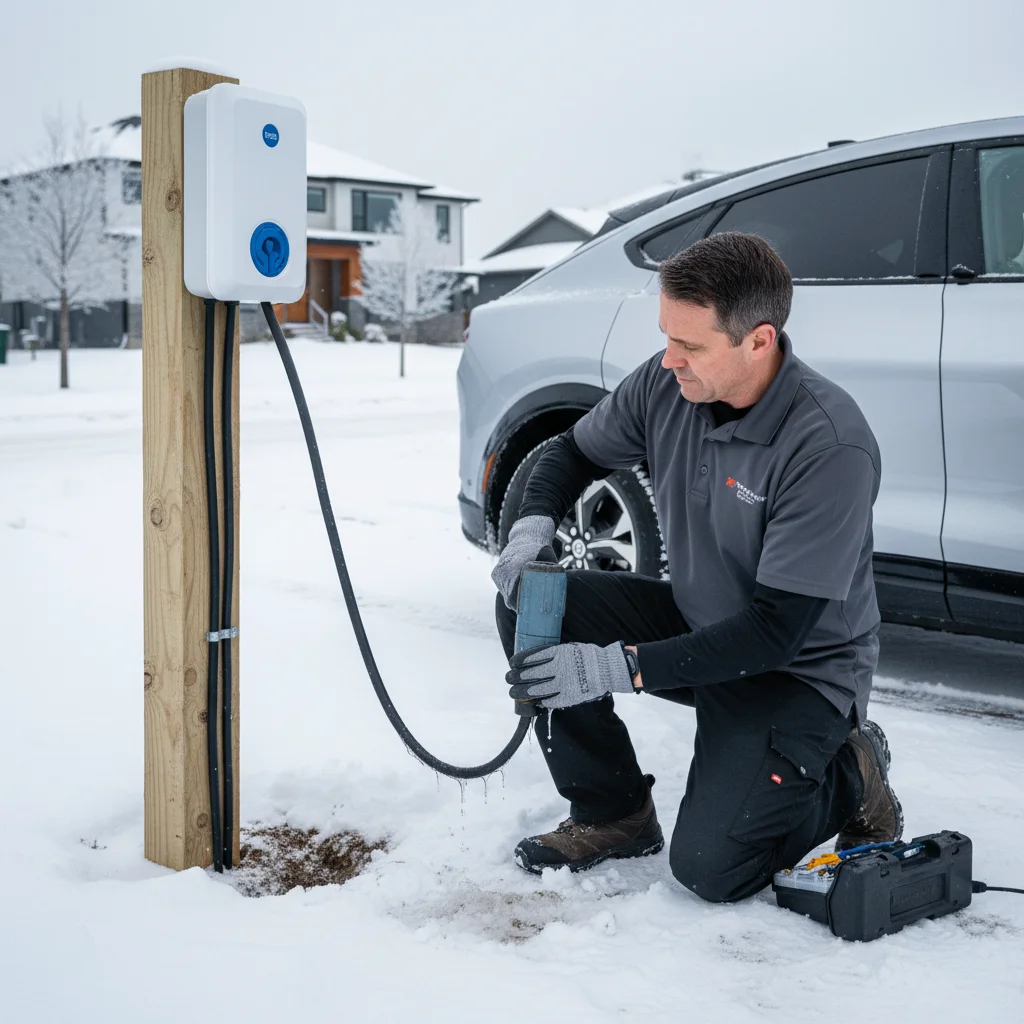
Why the Mach-E charge door and latch fail
The Mach-E uses two separate systems to manage the charge port: a motorized charge door that swings open on command, and an electronic latch inside the port that locks the CCS connector in place while charging. Both are electrically actuated. That’s convenient when everything works. When it doesn’t, you’re dealing with a software or power problem, not a stuck mechanical piece you can brute-force.
The most common failure modes in San Diego Mach-E ownership fall into a few buckets:
12V battery voltage drop. The Mach-E’s charge port latch and door motor both draw from the 12V auxiliary system. If that battery is weak — and Ford’s 12V batteries have a documented history of early degradation — the latch solenoid won’t get enough power to release. The car may look fully charged on the high-voltage side while the 12V is quietly starving.
Software freeze after a charging session. Particularly after DC fast charging at a public station, the vehicle’s Body Control Module can hold the latch locked if the session didn’t close cleanly. A hard power cycle sometimes clears it; sometimes it doesn’t.
Cold or heat warping. San Diego’s temperatures aren’t extreme, but coastal humidity combined with summer heat in areas like El Cajon or Santee can cause the charge door hinge to bind slightly, making an already marginal latch feel fully seized.
Charger-side lock. Some public EVSE stations — especially older ChargePoint and Blink units — hold their own software lock on the connector. The car releases fine, but the station won’t let go. We’ll cover that separately below.
Understanding which system is failing tells you where to start.
Manual release inside the frunk: step by step
Ford built in a manual override, and it’s worth knowing before you’re stuck in a parking garage. Here’s how to use it.
Step 1 — Open the frunk. You can open the Mach-E frunk from the Ford Pass app or by pressing the hood release inside the cabin. If the 12V is dead and the car won’t respond at all, you’ll need to jump the 12V first. There’s an auxiliary jump point under the hood behind a small plastic cover near the driver-side strut tower — positive terminal there, ground to a body bolt.
Step 2 — Find the release strap. Once the frunk lid is up, look toward the driver’s side of the frunk floor, near the back wall. There’s a bright orange (or yellow, on some model years) pull strap. It’s about the size of a large zip tie loop, and it’s anchored to a cable that runs to the charge port latch mechanism.
Step 3 — Pull the strap firmly. One steady pull — don’t jerk it. You should hear a soft click from the charge port area. The latch releases mechanically, independent of the 12V system.
Step 4 — Go back to the charge port and try the connector. Press the release button on the CCS handle and pull. The connector should slide free now.
Step 5 — Address the root cause. The manual release is a workaround, not a fix. If the latch failed because of a 12V issue or a software hang, it’ll happen again.
If the manual release doesn’t work — meaning the strap pulls but the connector still won’t come free — the problem is on the charger side, not the car.
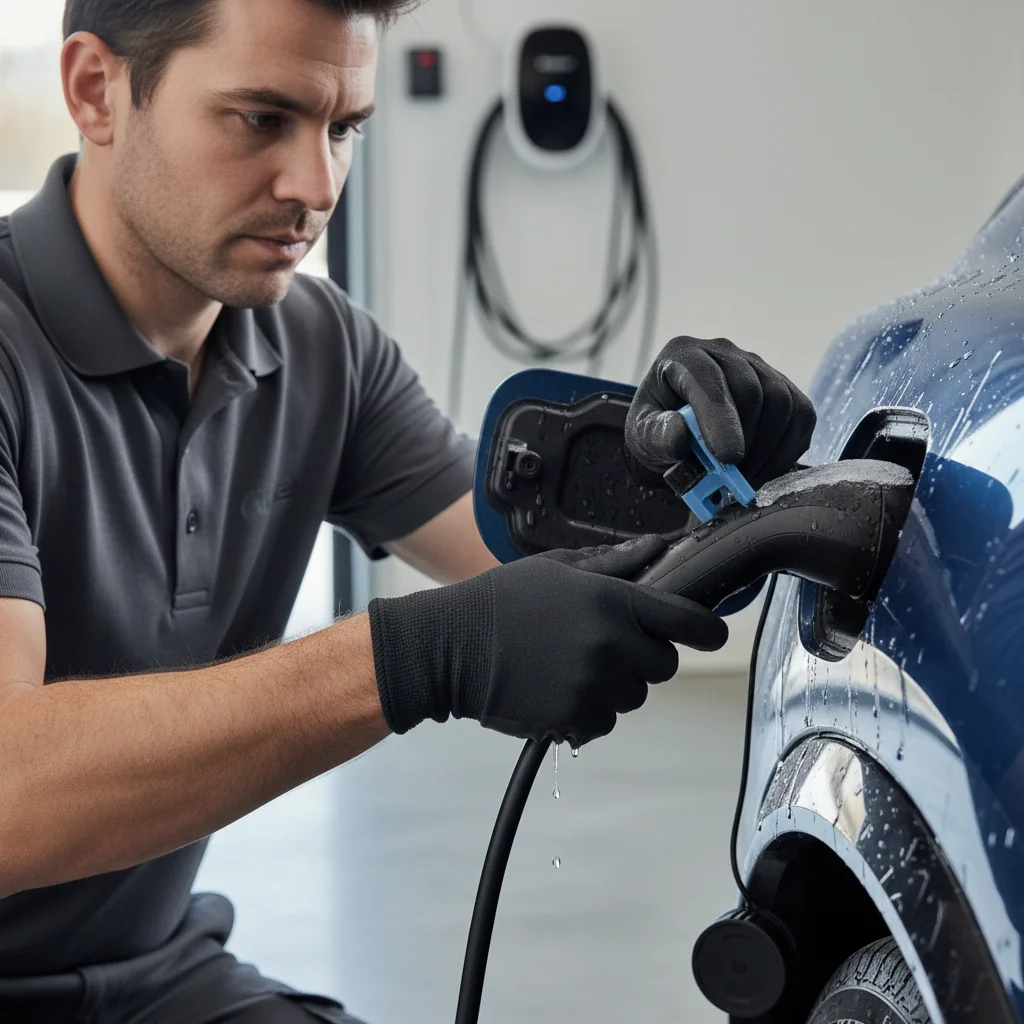
When the latch is electrical vs mechanical
This distinction matters because the fix is completely different.
An electrical latch failure means the solenoid that locks the connector got a command to release but couldn’t execute it — usually due to low 12V voltage or a Body Control Module glitch. Symptoms: the charge port light blinks but nothing moves, or the FordPass app shows a charging error and the port won’t respond to any input. The manual strap fix almost always works here because you’re bypassing the solenoid entirely.
A mechanical latch failure is rarer but nastier. It means the physical latching hook inside the port has bent, corroded, or jammed. In this case, the strap may feel like it pulls without resistance — because the cable to the hook is slack or disconnected — and the connector stays stuck. You won’t solve this in a parking lot. The port assembly needs hands-on inspection.
A good way to tell the difference: if the orange strap has firm resistance when you pull it, the cable is intact and you’re dealing with an electrical issue. If the strap pulls with almost no resistance and the connector doesn’t move, something is physically wrong inside the port.
For Mach-E owners who’ve already run the frunk procedure and are still stuck, our Non-Tesla EV Rescue service covers exactly this scenario — we carry the tools to assess and safely disengage a mechanically seized CCS connector without damaging the port.
What to do if the public charger won’t disconnect
This is its own problem, and it’s more common than most EV drivers realize. You’ve tried to end the session, the Mach-E shows the session complete, but the connector handle is locked solid. The station is holding it.
Here’s what to try, in order:
End the session through the station’s screen or app. Some EVSE units won’t release until you officially end the session through their interface — not just the car. ChargePoint, for example, requires you to swipe your card or use the app to formally close. If you walked away after the car hit 100%, the station might still think you’re active.
Call the network’s emergency line. Every major public charging network — Electrify America, ChargePoint, Blink — has a 24-hour support number printed on the station. Tell them the station ID (on the unit label) and ask them to remotely unlock. This takes 5-15 minutes but works the majority of the time.
Wait for a power reset. If a station loses power or reboots, it releases all connectors. This isn’t a great plan, but it’s worth knowing.
Don’t force it. Yanking a CCS connector that’s software-locked can crack the connector housing or bend the pins. Repairs on a Mach-E charge port aren’t cheap — the port assembly can run $400-800 at a Ford dealer, parts and labor.
For a broader look at stuck-connector scenarios across different EV models, the EV charge port won’t release guide covers the general troubleshooting tree. The Mach-E’s frunk strap is the most vehicle-specific piece; everything else translates.
When the latch won’t release and you’re stranded
Most Mach-E charge port issues resolve with the frunk pull strap or a quick call to the charging network. But some situations put you in genuinely stuck territory:
- The 12V is dead and you can’t get the frunk open at all
- The manual strap is broken or disconnected
- The CCS connector housing is physically damaged and won’t unlatch
- You’re at a public station late at night and the network’s support line has a 90-minute hold
In these cases, you need someone on-site, not a phone tree. That’s the scenario we cover with Non-Tesla EV rescue in San Diego. Mach-E calls come in regularly across San Diego County — Mission Valley, Chula Vista, the Eastlake charging corridors — and the pattern is almost always the same: a dead or weak 12V that took out the latch, compounded by a charging session that didn’t close cleanly at a public DCFC station.
Worth noting: the US Department of Energy’s AFDC tracks public EVSE reliability data, and CCS connector latch failures are among the leading reported issues at DC fast charging stations nationwide. This isn’t a Mach-E quirk — it’s a CCS infrastructure problem that Mach-E owners hit because they’re among the higher-mileage drivers using public DCFC regularly.
When to call Charge Pro
If you’ve pulled the frunk strap, the connector still won’t release, and you’re sitting in a parking lot with nowhere to be towed that will actually help — call us. We run mobile rescue across San Diego County specifically for non-Tesla EVs in situations like this: dead 12V batteries that killed the latch, mechanically seized connectors, and public charger lockouts where you need a person on the ground, not a call center.
Call us at (858) 808-6055 — we’ll roll a Cybertruck rescue truck to you.