You’re sitting on the shoulder of I-8 near El Cajon, battery at 0%, and the roadside app you called says their truck “may not have the right adapter.” That’s not a rare edge case — it’s exactly what non-Tesla EV owners in San Diego run into when they need rescue. The infrastructure built up around Tesla’s network doesn’t automatically extend to the rest of the EV market, and that gap matters when you’re actually stranded.
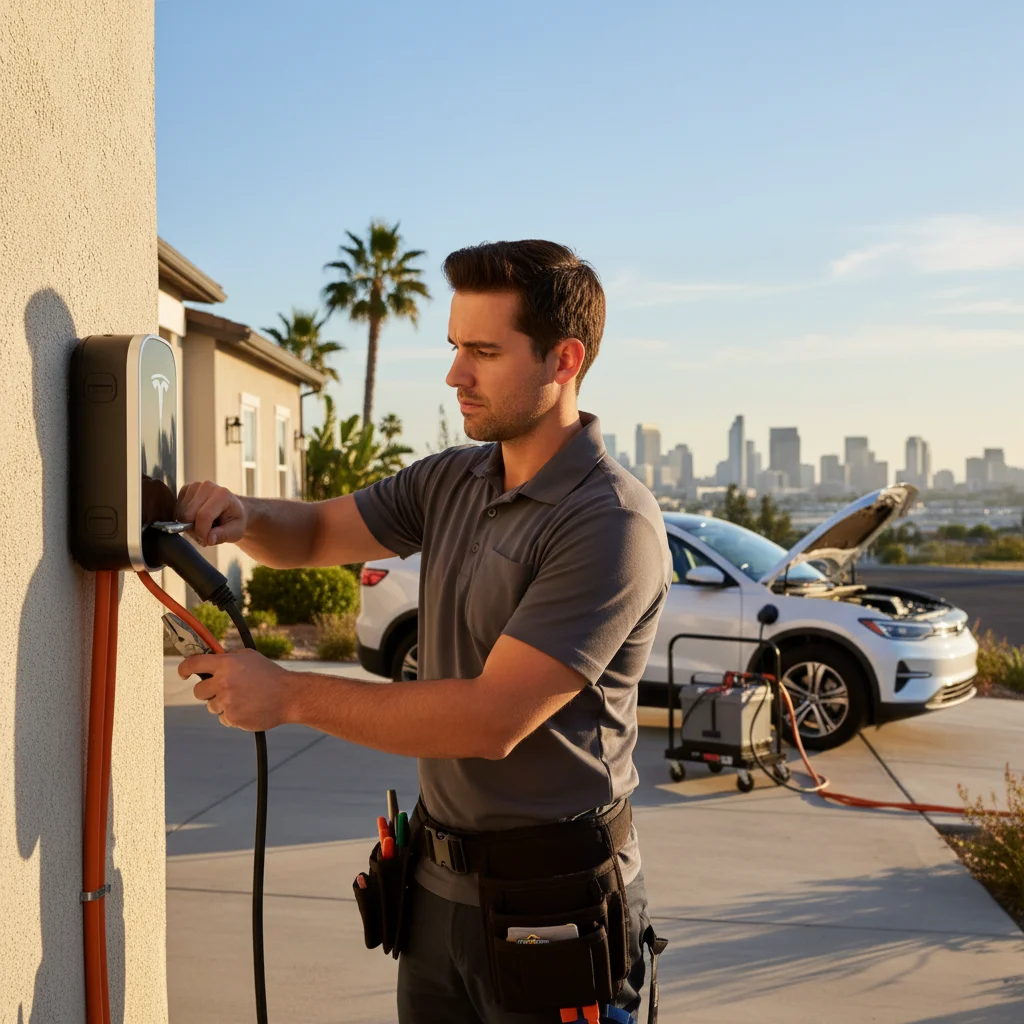
The non-Tesla rescue gap nobody talks about
Tesla’s roadside coverage works well because it’s vertically integrated. The company controls the cars, the app, the Supercharger network, and the dispatch system. When a Model 3 runs out of charge, Tesla’s own team knows exactly what connector to bring.
Every other automaker operates differently. Ford, Hyundai, Kia, Rivian, GM, Polestar — they all rely on third-party roadside providers who may or may not stock the right mobile charging equipment. Most tow operators carry a J1772 cable at best. Many carry nothing.
That’s the gap: not a failure of the cars, but a logistics mismatch between what’s on the road and what rescue fleets are actually equipped to handle.
San Diego makes this worse in a specific way. The county has one of the highest non-Tesla EV adoption rates in California, driven partly by CARB rebate programs and partly by the demographics of coastal and inland communities buying Rivians and Ioniq 5s in high numbers. More non-Tesla EVs on the road means more non-Tesla EV rescues needed — but the rescue infrastructure hasn’t kept pace.
According to the US Department of Energy’s Alternative Fuels Data Center, CCS and J1772 infrastructure nationally still trails Tesla’s proprietary network in density. In San Diego County, that translates to real coverage gaps, especially in East County and parts of North County inland where public DC fast chargers are sparse.
Our non-Tesla EV rescue service exists specifically because of this gap. We carry multiple connector types on every dispatch. No “we’ll see what we have” when we arrive.
What charging connectors we carry: CCS, J1772, NACS
Mobile EV rescue lives or dies on connector compatibility. Here’s what’s actually in play for non-Tesla vehicles right now.
CCS1 (Combined Charging System)
CCS1 is the dominant DC fast-charging standard for most non-Tesla EVs sold in the US. Rivian, Ford, Hyundai, Kia, GM (newer models), Polestar, and Volkswagen all use CCS1 for fast charging. It’s the large connector with two circular DC pins below the standard J1772 AC section.
Our mobile charging units support CCS1 delivery for emergency top-ups — enough range to get you to a proper charging station safely.
J1772
J1772 is the universal AC Level 2 connector. Almost every non-Tesla EV sold in North America has a J1772 port (or a CCS1 port, which accepts J1772 for AC charging). It’s slower than DC fast charging, but it works reliably for a rescue situation where you just need 10-20 miles of range added roadside.
NACS (North American Charging Standard)
Ford, GM, Rivian, and several other brands have committed to NACS — Tesla’s connector standard — for 2025 and newer model years. Some 2024 vehicles already shipped with NACS ports. We carry NACS-compatible equipment and adapters to cover this transition period, which is still very much ongoing in San Diego’s vehicle mix.
Not sure which port your car has? Check the driver’s side charge port door. CCS1 has a larger lower section. NACS looks like a smaller, rectangular plug similar to a Tesla connector. J1772 alone (without the DC pins below) is AC-only.
Our mobile EV charging trucks carry all three. That’s the whole point.
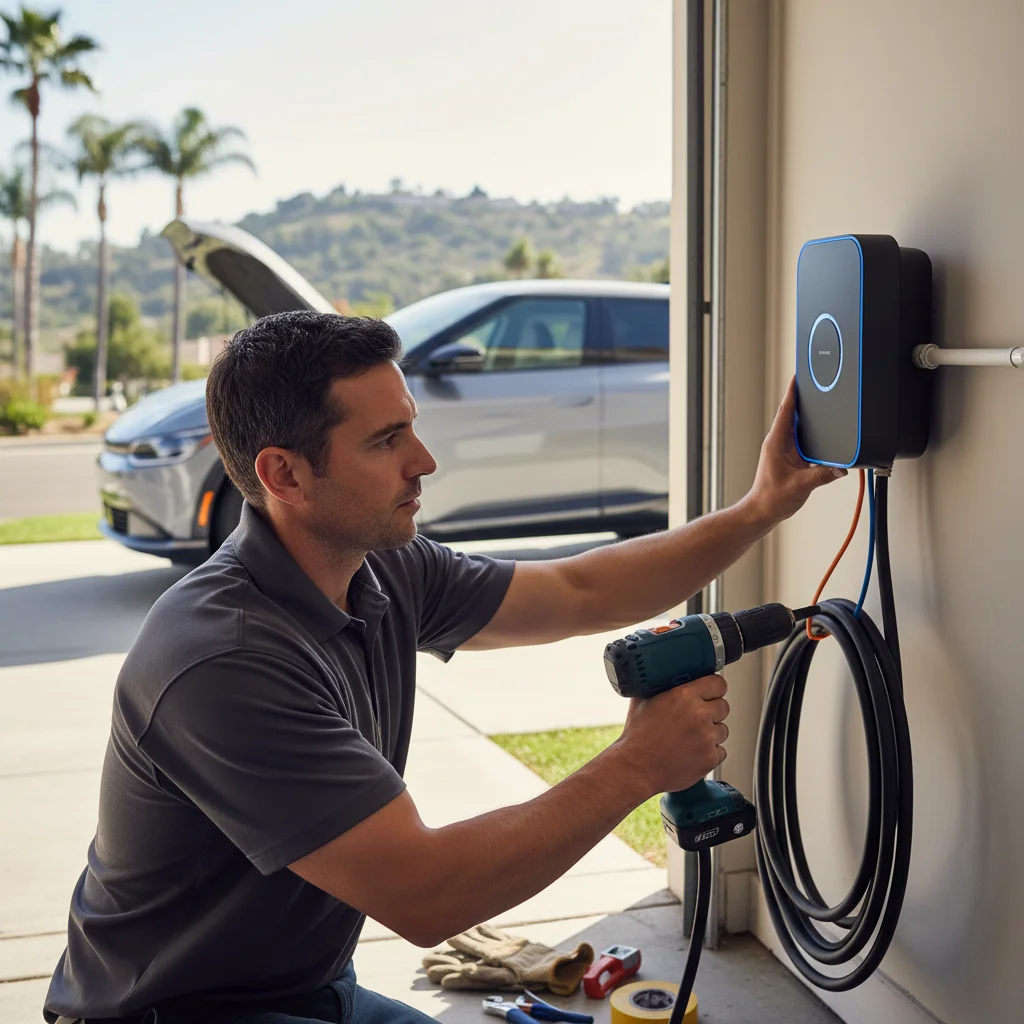
Brand-by-brand notes: Rivian, Ford, Hyundai, Kia, GM, Polestar
Different EVs have different quirks that affect how a rescue actually goes. Here’s what we’ve learned working with each of these vehicles on San Diego roads.
Rivian R1T and R1S
Rivian’s charge port is on the driver’s side rear. The vehicle needs to be powered on (or at least in accessory mode) for the charge port door to open — which can be tricky if the 12V auxiliary battery is also depleted. If your Rivian won’t open the charge port at all, there’s a manual release cable accessible behind the rear driver’s side trim panel. We know where it is.
Rivian uses CCS1 for DC charging, though 2024+ models are transitioning to NACS. Check your model year before assuming.
Ford Mustang Mach-E and F-150 Lightning
The Mach-E’s charge port release is electronic, which means a dead 12V battery can lock it closed. Ford included a manual release on the Mach-E — there’s a pull tab inside the front trunk (frunk) that releases the port mechanically. The F-150 Lightning has a similar setup. Knowing this before the truck arrives saves time.
2024 Lightning models came standard with NACS. Earlier models use CCS1. Our article on Ford Mach-E roadside situations covers the charge port release issue in more detail.
Hyundai Ioniq 5, Ioniq 6, and Kia EV6
These vehicles have large battery packs — the Ioniq 5 Standard Range sits around 58 kWh and the Long Range at 77.4 kWh — which means they take a meaningful amount of energy to move the needle on range. A mobile rescue top-up will add enough to reach a charger, not necessarily to top the battery. Our Hyundai Ioniq 5 battery and capacity breakdown has the full numbers if you want to plan around them.
Both brands use CCS1 currently. Neither has announced a near-term NACS transition.
GM: Chevy Equinox EV, Silverado EV, GMC Sierra EV
GM fully committed to NACS for its 2025 model year and is rolling out adapters for older vehicles. The GMC Sierra EV in particular has been popular in San Diego’s North County market. We wrote a separate piece on GMC Sierra EV emergency charging that covers the specifics. Earlier Bolt EV/EUV models use CCS1 and remain common on San Diego roads.
Polestar 2 and 3
Polestar uses CCS1. The charge port is on the driver’s side rear. One Polestar-specific note: the car’s energy management can sometimes prevent charging if it detects a fault state. If a rescue charge isn’t initiating, a soft reset (holding down the center console button) often clears it.
What to do while you wait
If you’re stranded and you’ve already called for rescue, here’s how to make the wait safer and shorter.
Stay in the car if you’re on a freeway. I-5, I-8, I-15, and SR-78 have fast-moving traffic. Pull as far right as you can, turn on hazards, and stay inside with your seatbelt on until help arrives. Exit the vehicle on the passenger side if you must get out.
Check your remaining 12V battery power. Your EV has two batteries: the traction pack that drives the wheels, and a small 12V auxiliary battery that runs the car’s electronics. If the 12V is also low, your charge port may not open and your hazard lights may dim. Let the dispatcher know if you’re seeing low-voltage warning lights separate from the range warning.
Open the charge port manually if needed. Most EVs have a manual release. Check your owner’s manual or the glove box card for the location. Accessing it before the truck arrives speeds things up.
Use PlugShare to find the nearest working charger. Even if you can’t reach it now, knowing where you’re going after a rescue top-up avoids a second stop.
Don’t try to push the car yourself on a freeway shoulder. EVs are heavy — the Rivian R1T weighs over 7,000 pounds. Wait for the rescue truck.
Why San Diego non-Tesla owners get stuck more often
It’s not just about density. San Diego’s geography creates specific range traps.
East County routes — SR-94 through Jamul, the stretch of I-8 from Alpine toward the county line — have long gaps between public chargers. Someone leaving El Cajon for a mountain weekend in a Kia EV6 can easily misjudge available range if they’re not accounting for the elevation gain on the return trip. Climbing from sea level to 4,000 feet chews through battery faster than flat freeway driving.
North County coastal routes present a different problem: traffic. Sitting on the 5 through Carlsbad or Encinitas in stop-and-go adds range anxiety when a driver is already watching the battery bar. The California Energy Commission tracks charging infrastructure deployment, but even with recent expansion, the ratio of CCS stations to non-Tesla EVs in San Diego County remains tighter than the LA basin.
Add in the fact that non-Tesla roadside programs from AAA and most automaker assistance lines often can’t dispatch a mobile charger at all — they’ll offer a tow instead — and you have a real coverage problem. A tow to a charging station is a two-hour ordeal. A mobile rescue top-up gets you moving in 20-30 minutes.
When to call Charge Pro
If your non-Tesla EV is stranded with no charge, if your charge port won’t open, or if you’re watching the battery drop and know you won’t make it to the next station — that’s the moment to call us, not after you’re already stopped on the shoulder.
Our non-Tesla EV rescue dispatch covers San Diego County with CCS1, J1772, and NACS equipment on every truck. We don’t guess at connectors when we arrive.
Call us at (858) 808-6055 — we’ll roll a Cybertruck rescue truck to you.