You’re on the side of the I-15 near Miramar, or maybe in a parking garage in Little Italy. Your Tesla’s screen is black, or you’ve run out of charge. You use the app to request roadside assistance, a countdown timer appears, and you wait. But who are you waiting for? Who actually shows up when you call Tesla for help in San Diego?
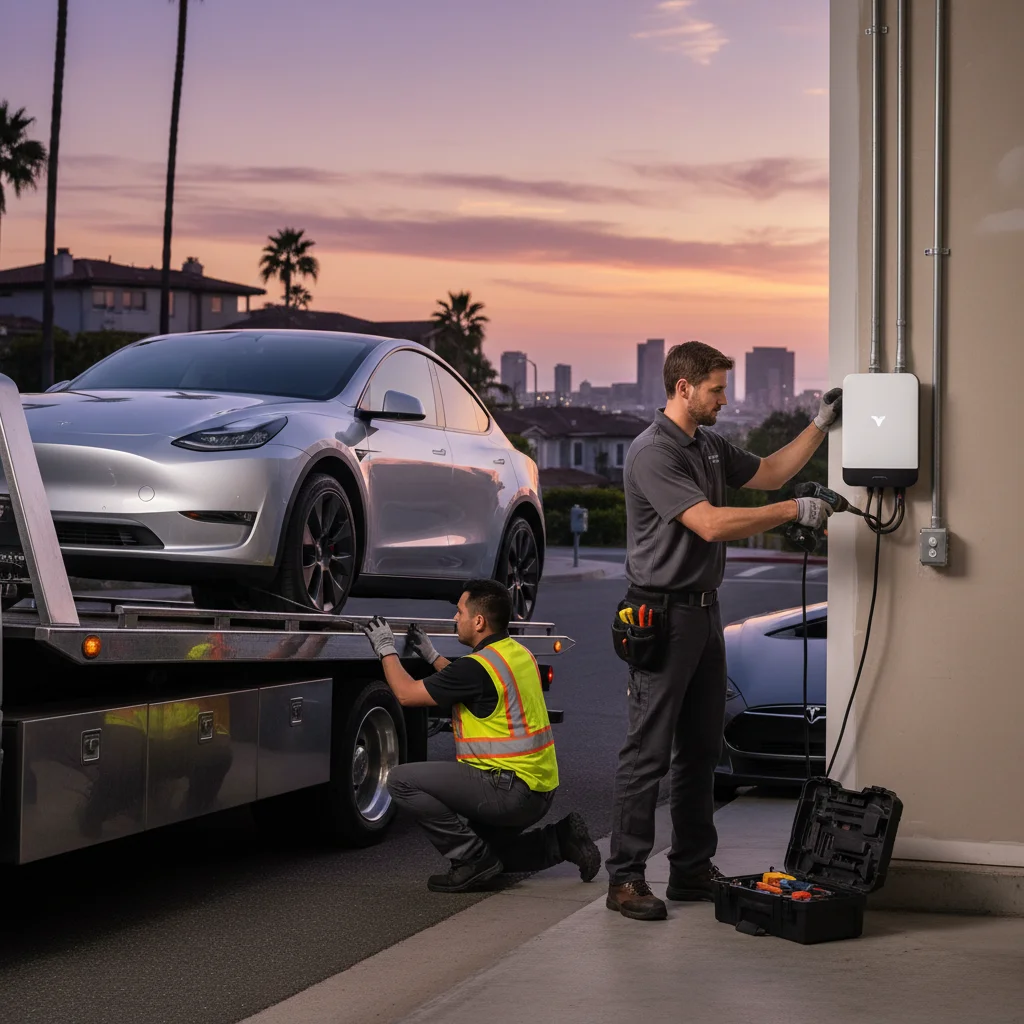
How Tesla dispatches roadside in San Diego in 2026
Unlike car companies of the past, Tesla doesn’t own and operate a massive fleet of branded tow trucks. Instead, they rely on a nationwide network of independent, third-party towing companies to handle roadside events. Here in San Diego County, when you tap that “Request Help” button in your app, Tesla’s system acts as a dispatcher, not a service provider.
The request is broadcast to a pool of local tow operators who have contracted with Tesla. The system typically prioritizes two things: proximity and speed. It pings the closest available truck that is part of their network. The first driver to accept the job gets the call and is routed to your location. This model is efficient for covering a large geographic area like ours, from Chula Vista to Oceanside, without Tesla having to build its own physical infrastructure.
However, this focus on speed and availability means there’s little to no guarantee of specific expertise. The system doesn’t ask, “Which nearby driver has the most experience with a Model 3 Performance with a dead 12V battery?” It simply asks, “Who can get there the fastest?” Whether you use the app or call the roadside phone number makes little difference; the underlying dispatch logic is the same. The result is a highly variable experience. One day you might get a seasoned pro, and the next you might get someone whose primary job is towing ICE vehicles.
Who the third-party contractors actually are
The companies that respond to Tesla roadside calls are the same local tow businesses you see all over San Diego County. They are independent operators who contract with multiple motor clubs, insurance companies, and manufacturers, including Tesla. Their fleet consists of flatbeds, wheel-lift trucks, and heavy-duty wreckers designed to service every kind of vehicle on the road.
These are legitimate, hardworking local businesses. The issue isn’t their professionalism, but their specialization. For most of these companies, EVs are still a small fraction of their daily calls. Their drivers are experts at handling common gas-powered car issues, but they may have only received minimal, often online, training for the specific needs of a Tesla.
This contractor model means that the person who shows up might have towed five Teslas this year, or they might be towing their first one ever. Driver turnover in the towing industry can also be high, meaning any training provided might not reach the specific person responding to your call. They are generalists in a situation that often requires a specialist’s touch. They are paid per job, creating an understandable incentive to complete the service quickly and move on to the next one, which can sometimes be at odds with the careful, deliberate process required to safely handle a disabled EV.
Why your Tesla might end up on a non-EV-trained tow
The core reason you might get an inexperienced operator is simple supply and demand. On a busy Friday evening, with incidents scattered across the 805, 5, and 15 freeways, the pool of available tow trucks shrinks. Tesla’s dispatch system will grab the first available partner. If the most EV-savvy operators are already on other calls, your request will fall to the next in line, regardless of their specific training.
Tesla provides digital resources and instructions to its contractors for handling their vehicles. However, reading a manual on a phone on a dark, noisy freeway shoulder is very different from having hands-on experience. The official Tesla Roadside Assistance policy for 2026 covers what services are included, but it can’t guarantee the skill level of the individual contractor who arrives.
Think about the unique challenges a Tesla presents. A dead 12V battery can render the car completely inert, with no way to open doors or access the touchscreen to put it in neutral. A trained EV technician knows how to pop the frunk with an external power source to access the 12V terminals. A general tow operator might not, leading to confusion and potential damage trying to force things. This gap between the car’s requirements and the operator’s training is where problems begin.
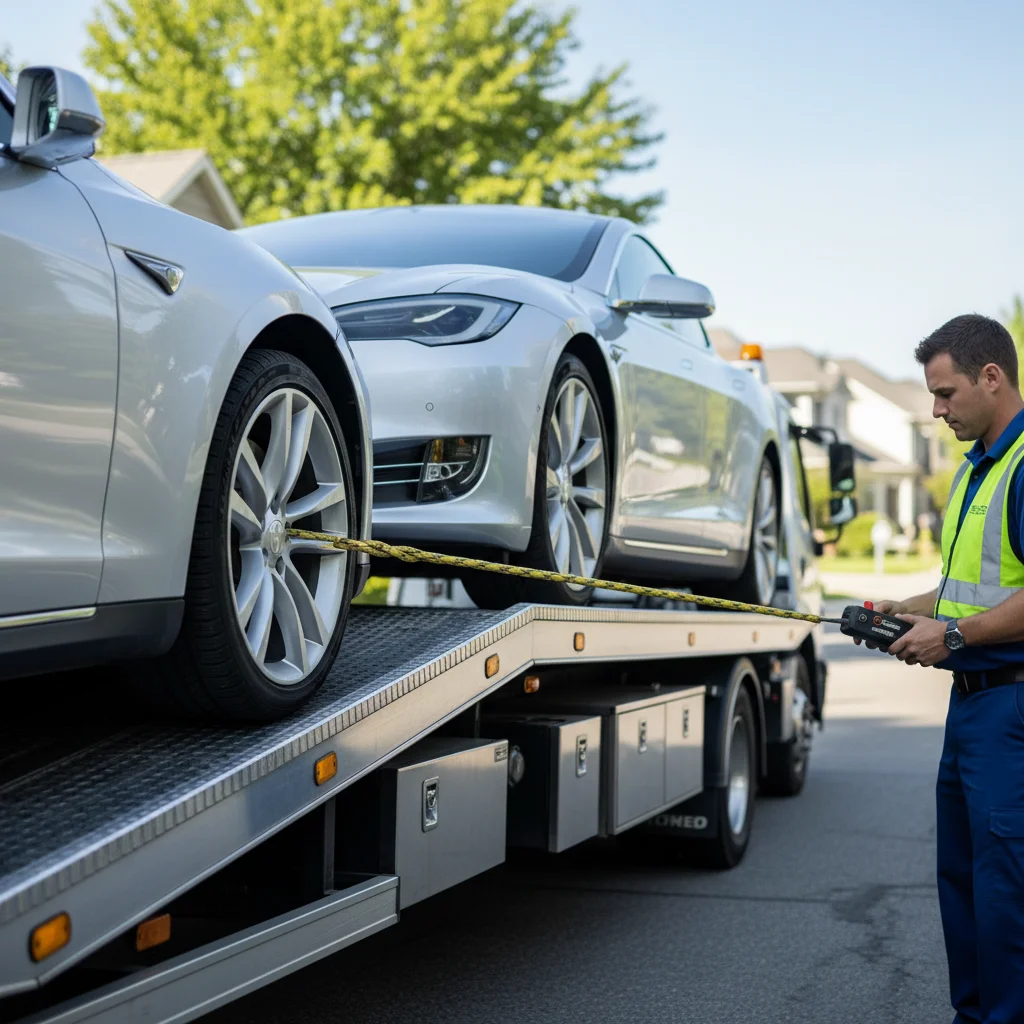
Damage risk from incorrect flatbed loading
This is the most critical part of the process and where lack of training can lead to expensive damage. Every Tesla, without exception, must be transported on a flatbed tow truck. This is non-negotiable, especially for Dual Motor (AWD) models. Using a traditional hook-and-chain or a dolly tow (where two wheels are on the ground) can destroy the drive units, leading to a repair bill in the tens of thousands of dollars.
Here’s what must be done correctly:
Engaging Transport Mode
The car needs to be put into neutral so its wheels can spin freely. The proper way is through the touchscreen: Controls > Service > Towing. This activates Transport Mode, which disengages the parking brake and allows the car to be winched onto the flatbed. If the operator doesn’t know this and tries to drag the car with the parking brake engaged, it can damage the brake system and tires.
What if the screen is dead?
This is a common scenario. A dead 12V battery means a dead touchscreen, making it impossible to engage Transport Mode electronically. A trained technician knows there’s a manual procedure for this, but it’s not intuitive. They also know that the first step is often to jump the 12V battery to bring the car back to life. An unprepared operator might simply try to drag the car onto the flatbed, causing severe damage.
Correct Winching
The car must be pulled onto the flatbed using the designated tow eye. This is a metal loop that screws into a hidden access point in the front or rear bumper. Hooking the winch cable to suspension components, the subframe, or control arms can bend or break them, compromising the car’s alignment and safety.
If the wheels are locked and cannot be freed, the only safe way to move the vehicle is by using wheel dollies (often called GoJaks). These are small platforms that slide under each tire, lifting them off the ground so the entire car can be rolled onto the flatbed without dragging the wheels.
When to refuse the dispatch and call a local mobile rescue
As the owner, you have the right to refuse service if you feel the responding operator is not equipped to handle your car safely. Trust your gut. It is far better to wait a little longer for the right service than to rush and risk thousands in damage.
Watch for these red flags when the truck arrives:
- It’s not a flatbed. If any truck other than a flatbed arrives, refuse the service immediately.
- The driver is confused. If they ask you how to open the charge port, don’t know what Transport Mode is, or seem unsure how to handle the car, it’s a bad sign.
- They want to hook onto the suspension. If you see them trying to attach the winch hook anywhere other than the designated tow eye location, stop them.
- They have no plan for a dead screen. If your car is completely dead and they don’t mention jumping the 12V battery or using wheel dollies, they are unprepared.
If you encounter any of these situations, you can cancel the tow through the Tesla app and seek a better option. Instead of rolling the dice with another random dispatch, your best bet is to call a company that specializes in EV-specific problems. A dedicated service like Charge Pro SD’s Tesla Roadside Rescue sends technicians, not just tow drivers, who understand the unique electrical systems of your vehicle.
When to call Charge Pro
If you’re stranded with a dead Tesla, a locked screen, or you just don’t feel confident in the tow truck that arrived, don’t risk it. We specialize in no-tow rescues for common problems like dead 12V batteries or an empty main battery, getting you back on the road faster and safer.
Call us at (858) 808-6055 — we’ll roll a Cybertruck rescue truck to you.