Your battery hits zero somewhere between the Nordahl Road on-ramp and the Westfield North County exit, and suddenly I-15 feels very long. Escondido sits at the northern edge of the San Diego metro, and that geography — highways, hills, and gaps in the charging network — creates a specific set of problems for EV drivers. Here’s what to know before you need us, and what happens when you call.
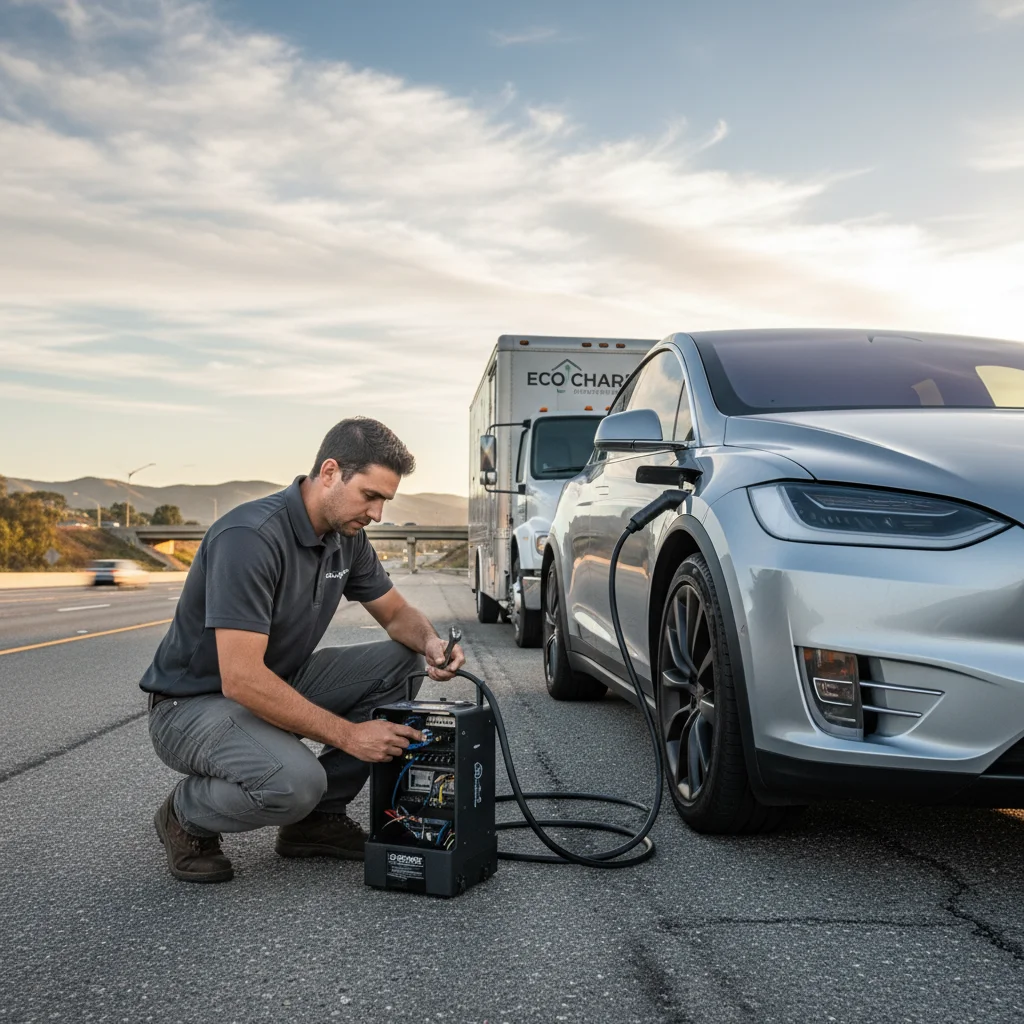
Where Escondido EV drivers run out of charge
Escondido covers a lot of ground. The city stretches from the valley floor up through the foothills toward Valley Center, and that elevation change is one of the biggest surprises for EV owners who moved here from a flatter part of the county.
The climb from downtown Escondido up Quince Street or Bear Valley Parkway can pull 8–12 miles of estimated range just on the ascent, depending on your vehicle and how warm the battery is. Drivers who leave Westfield North County with what looks like plenty of range sometimes find themselves short by the time they reach Valley Center Road or the 78 junction.
The other common scenario is range creep — drivers who leave home in the morning with 60–70% charge, run errands along the El Norte Parkway corridor, swing by a shopping center, and then face a longer-than-expected freeway commute home. By the time they merge onto I-15 southbound at Valley Parkway, the math doesn’t work anymore.
Cold mornings in Escondido also matter more than most people expect. Temperatures in the valley drop into the low 40s from November through February, and lithium-ion batteries lose real capacity below 50°F. If you parked outside overnight and your car shows 80% in the morning, actual usable range can be 10–15% lower than that number suggests — a gap that catches people off guard on a longer drive to downtown San Diego.
I-15 and SR-78 stranded-EV hotspots
Both freeways that serve Escondido show up consistently in Caltrans stranded-EV incident data. I-15 between the Centre City Parkway interchange and the Deer Springs Road exit is one of the busiest stretches for EV stalls in North County. The highway climbs here, the shoulders are narrow in spots, and the nearest public fast-charger is not walking distance from any of those exits.
SR-78 westbound is its own challenge. From the I-15 junction heading toward San Marcos, there’s a stretch where exits are sparse and turnaround options are limited. Drivers who run low on that segment often can’t safely exit before the battery gives out entirely. The US Department of Energy’s AFDC charger map shows the gap clearly — fast-charging infrastructure thins out quickly once you leave the I-15 corridor.
A few other local hotspots worth knowing:
Valley Center Road and Bear Valley Parkway
The uphill stretch toward Valley Center sees multiple calls per month, especially on warm weekends when drivers are heading to wineries or resorts and underestimate the range cost of the climb.
Auto Park Way near the dealership row
Ironically, the strip of car dealerships on Auto Park Way generates occasional EV calls — test drives that go longer than expected, or buyers who drive a new vehicle off the lot before fully charging it.
Residential dead-ends in the hills
Newer construction neighborhoods east of I-15 sit at elevation. Visitors using navigation apps sometimes arrive with less charge than they expected and can’t get back without help.
What Charge Pro brings to an Escondido call
When you call us for EV roadside assistance in Escondido, we dispatch a technician in a purpose-built rescue truck — a Cybertruck-based rig carrying a high-capacity mobile power unit. It’s not a tow truck. It’s not a jump pack from a gas-station kit. The unit we carry can deliver enough charge to get most passenger EVs 20–40 miles of range in a single roadside stop.
Our out-of-charge recovery service works across all major EV makes and models. That includes Tesla, Rivian, Ford F-150 Lightning, Hyundai IONIQ 5 and 6, Kia EV6, Chevy Equinox EV, and others. We carry adapters for CCS, CHAdeMO, and NACS connections.
What we don’t do is install charging equipment — that’s a job for a licensed electrician. What we do is get you moving again when you’re stuck.
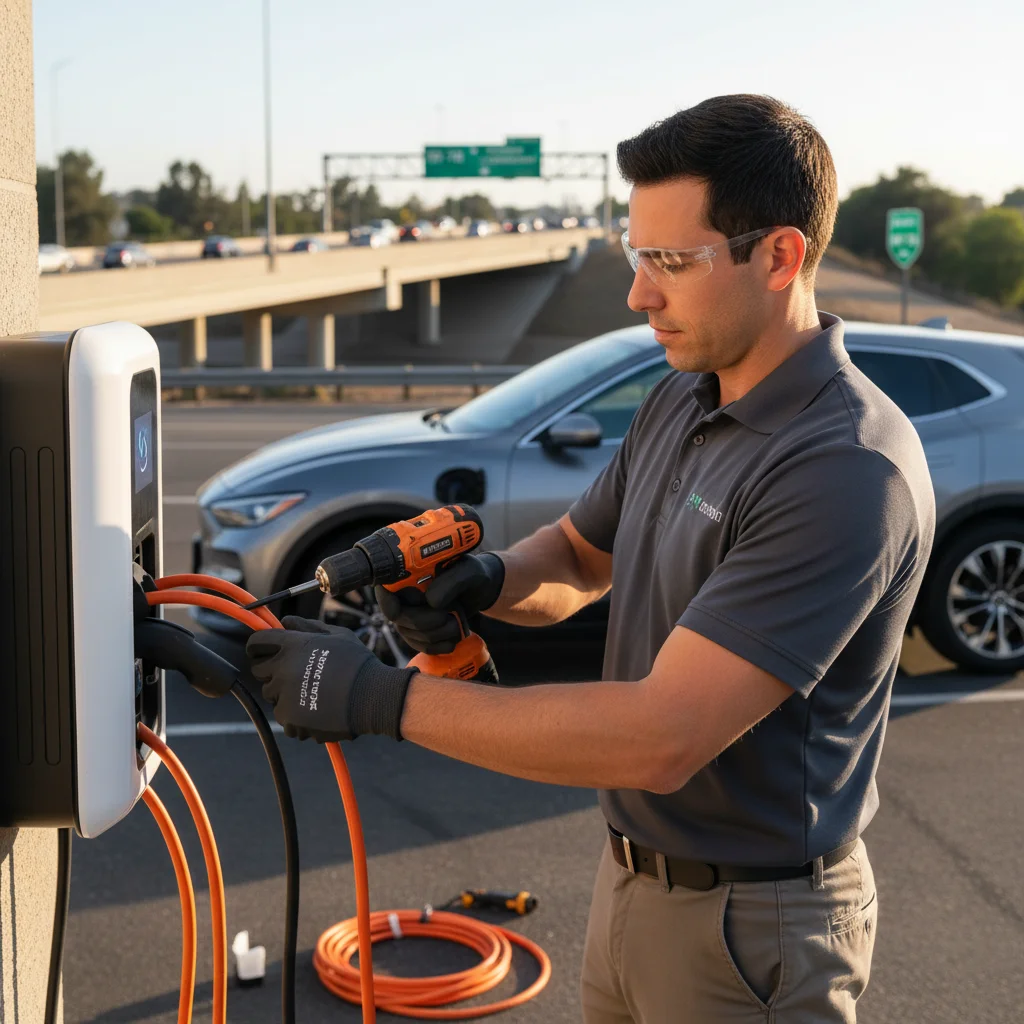
The process on a freeway call follows a specific sequence. We confirm your exact location — not just “I-15 near Escondido” but the nearest mile marker or exit — and we stay on the line while you wait. Our technician sets up behind your vehicle with warning triangles and works quickly. Most freeway calls are wrapped in under 30 minutes from arrival.
For residential calls in Escondido — say, a dead battery in your driveway or a car that won’t move from a parking structure at Westfield North County — the setup is more relaxed, but we bring the same equipment and the same process.
Response times from our nearest staging point
Charge Pro SD covers all of San Diego County, and our North County staging puts us within a reasonable window of Escondido on most calls. From our nearest active unit, typical response time to central Escondido runs 25–40 minutes depending on traffic on I-15 and time of day.
Calls during the morning commute window (7–9 a.m.) or late afternoon (4–6 p.m.) can run longer because I-15 through Escondido is genuinely congested during those hours. If you call during peak traffic, we’ll give you an honest ETA — not a number we made up to keep you calm.
Calls on SR-78 between Escondido and San Marcos fall within the same response window. For drivers stranded further out — Valley Center, Rincon, or Harmony Grove — we’ll still come, but we’ll quote a realistic time. Count on 45–60 minutes for those outer-area calls.
You can read more about how our response coverage works across the county in our guide to mobile EV charging near San Diego.
Mobile charge vs tow for North County drivers
This comparison comes up on almost every first call from a new customer. The short answer: a mobile charge is faster, cheaper, and less stressful than a tow in almost every stranded-battery situation.
A tow from I-15 in Escondido to a fast-charger — assuming one is available and the driver knows where to go — costs $100–$200 or more depending on distance and the tow company. You lose your car for 30–90 minutes minimum. You have to arrange a ride or wait at a shop. Then you still need to charge. For a detailed breakdown of why mobile charging beats towing for most stranded EVs, we’ve covered the full comparison elsewhere.
The one scenario where a tow makes more sense: if your vehicle has a mechanical fault beyond the battery. A flat tire, a charge port that won’t open, a 12V battery failure, or a drivetrain fault code — those situations may need a shop visit. But if your only problem is that the battery hit zero, you don’t need a tow. You need charge.
The California Energy Commission has been tracking EV adoption rates across the state, and North County San Diego is one of the fastest-growing EV markets in California. More EVs on Escondido streets means more drivers encountering range situations for the first time. If you’re new to EV ownership, check your public charging options on PlugShare before longer drives — knowing where the nearest fast-charger sits along your route takes most of the anxiety out of the math.
For North County drivers comparing options across the corridor, our posts on EV roadside assistance in Carlsbad and EV roadside assistance in Oceanside cover the neighboring cities with the same level of detail.
When to call Charge Pro
If your EV battery hit zero — on I-15, on SR-78, on the climb to Valley Center, or in a parking lot off El Norte Parkway — that’s the call. Same if your 12V battery died and your car won’t unlock or power on. Same if you’re close to empty and you’re not confident you’ll make it to the nearest charger. We don’t judge the situation. We just come.
Call us at (858) 808-6055 — we’ll roll a Cybertruck rescue truck to you.