It’s one of the best drives in San Diego County, but it can quickly become one of the most stressful. You’re cruising down Coast Highway 101, windows down, taking in the scene at Cardiff Reef or Swami’s, when you see the low battery warning. Suddenly, the nearest fast charger feels a world away, and the beautiful Pacific becomes a backdrop for classic range anxiety.
Why coastal Encinitas EVs run dry mid-trip
A dead EV battery on the coast isn’t usually about poor planning. It’s a classic case of a perfect day changing your plans. You might leave home in Carmel Valley or Rancho Santa Fe with 60% charge, thinking it’s more than enough for a quick surf check or lunch in downtown Encinitas. But then the surf is good, so you stay. You decide to cruise up through Leucadia, find a tight parking spot, and run the AC while you wait for a friend.
This “beach day-strand pattern” is common. Here’s why it catches drivers off guard:
- Spontaneous Cruising: The stretch from Cardiff to Leucadia is scenic. It’s easy to burn an extra 5-10 miles of range just driving back and forth, looking for parking, or deciding where to eat.
- Charger Deserts: While there are Level 2 chargers scattered around, DC fast chargers—the kind you need for a quick top-up—are sparse along the immediate coast. Most are located east of I-5, requiring a significant detour and enough battery to get there. As you can see on a map like PlugShare, your options right on the 101 are very limited.
- Topography Traps: The final leg of your journey is often uphill. Whether you’re taking Birmingham Drive or Encinitas Boulevard to get back to the I-5 connector, that climb demands a lot of power. An EV that read “10 miles” of range on the flat coast might not make it up the grade to the freeway on-ramp.
This unique combination of factors is why so many drivers need an ev rescue encinitas 101 service. It’s not just about a single miscalculation; it’s how a great day at the beach can slowly drain your battery without you noticing. For a broader overview, you can read our general guide to EV roadside assistance in Encinitas, but this coastal corridor has its own specific challenges.
Coast Highway 101, Leucadia, and Cardiff hotspots
Certain spots along this corridor are notorious for leaving EVs stranded. Knowing them can help you stay aware of your state of charge before it becomes critical.
- Cardiff-by-the-Sea (Restaurant Row to Swami’s): This is a primary hotspot. Traffic is often slow and stop-and-go, especially on a sunny weekend. You’re idling, creeping, and running your climate control, all of which consumes more energy than steady cruising. The shoulders are narrow, and if your battery gives out here, you’re in a tough spot with traffic buzzing by.
- Downtown Encinitas (D Street to Moonlight Beach): The search for parking is the main culprit here. Circling the block multiple times can easily eat through your last few kilowatt-hours. The public chargers at City Hall or the Coaster station are often occupied, leaving you with no easy options if you’re already critically low.
- Leucadia (La Costa Ave to Leucadia Blvd): The northern stretch of the 101 through Leucadia is beautiful but also a common place for a
coast highway ev strandedevent. The road is narrower, and there are fewer turn-offs. If you run out of charge here, you’re likely blocking a travel or bike lane, creating an immediate traffic issue. We see many calls forleucadia ev roadsidehelp from drivers who enjoyed the shops and cafes a little too long. - The I-5 Connectors: The intersections at Encinitas Boulevard and Birmingham Drive are critical failure points. Drivers realize they don’t have enough range to make it home and try to divert to a charger, only to find the uphill climb to the freeway is the final straw for a depleted battery.
In each of these hotspots, the problem is the same: a lack of immediate, fast charging infrastructure combined with driving patterns that drain batteries faster than a typical commute.
What CHP and sheriff expect on a narrow shoulder
Getting stranded is stressful enough. Dealing with law enforcement adds another layer, but their priority is simple: safety. The shoulders along many parts of the Coast Highway are tight, non-existent, or designated as bike lanes. If your EV dies, you could be a serious hazard.
Here’s what to do and what to expect:
- Safety First: The moment you realize you’re losing power, turn on your hazard lights. This is the universal signal for distress and is your most important first action.
- Pull Over Safely: Do your best to coast as far to the right as possible. If you can make it to a side street, a designated parking spot, or a dirt turnout, do it. Avoid stopping in the middle of a traffic lane or a bike lane at all costs. The stretch near the Cardiff Kook, for example, offers almost no shoulder.
- Stay in the Vehicle: On a busy road like the 101, the California Highway Patrol advises that it’s almost always safer to remain in your car with your seatbelt on. Standing next to your vehicle exposes you to traffic.
- Have a Plan: When a San Diego Sheriff’s deputy or a CHP officer arrives, they’ll want to know your plan to clear the vehicle. Saying “I don’t know” or “I’m waiting for a friend” might result in them calling their designated tow service to clear the road quickly.
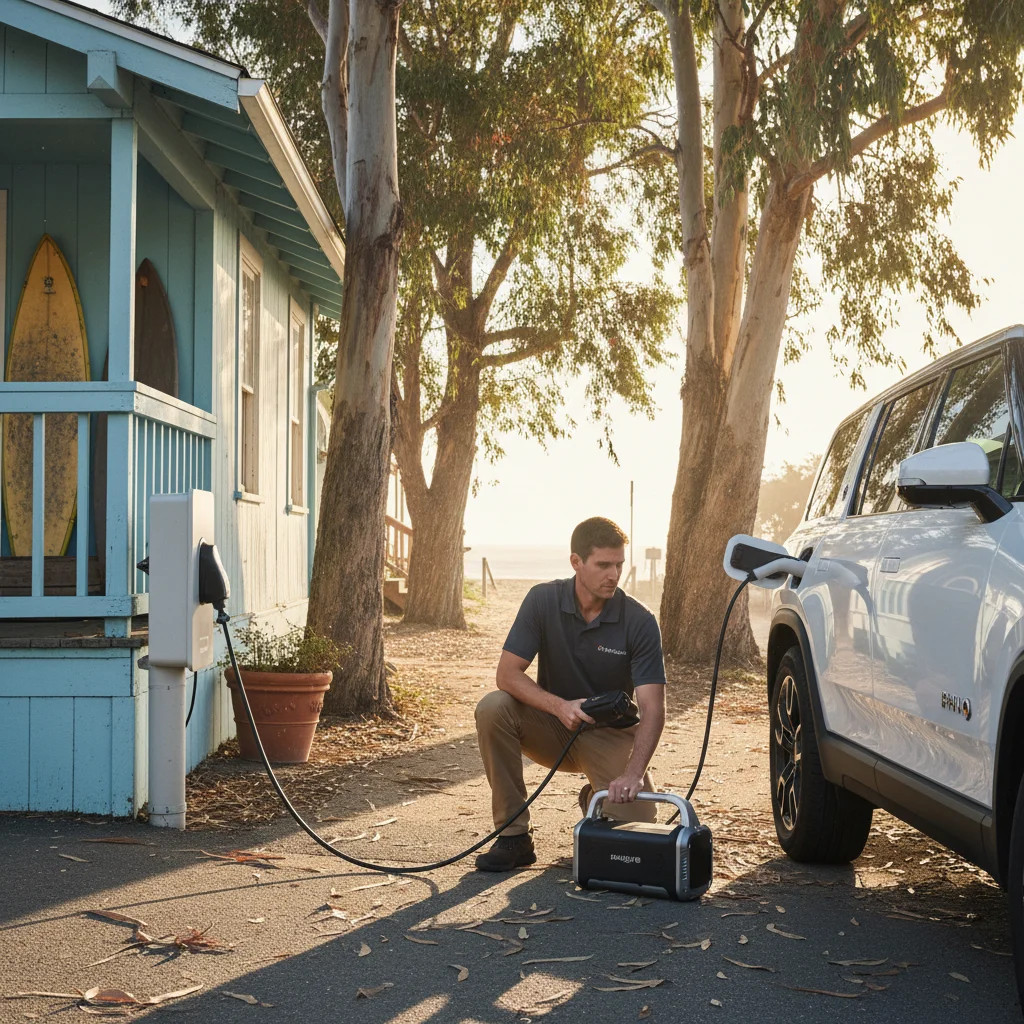
Having a professional ev roadside cardiff coast highway service like Charge Pro SD on the way shows them you have the situation under control. You can provide our ETA and explain that a mobile charging unit is en route, which is a much faster and more efficient solution than waiting for a flatbed.
Our coastal staging and dispatch times
A fast response time is critical when you’re stranded on a busy coastal highway. A long wait isn’t just an inconvenience; it’s a safety issue. That’s why Charge Pro SD doesn’t operate from a single, distant depot. We use a strategic staging model to ensure we can reach you quickly, especially in high-traffic corridors like Encinitas and Cardiff.
Our rescue trucks are positioned near key access points, like the I-5 corridor, allowing us to jump onto Leucadia Boulevard or Santa Fe Drive and get to the coast in minutes. We know the local traffic patterns, the back roads, and the safest places to conduct a roadside charge.
When you call us, you’re not calling a national dispatch center that has to find a local contractor. You’re calling a dedicated San Diego team. We can typically provide a precise ETA and have a truck on-scene along the Encinitas-Cardiff coast in 30 to 45 minutes.
This rapid deployment is a core part of our emergency EV roadside assistance. We understand that an out-of-charge recovery situation requires urgency. Our goal is to get you charged and safely on your way before a traditional tow truck has even been dispatched.
Mobile charge vs tow for beach-town drivers
When your EV runs out of battery, you have two main options: call for a tow or call for a mobile charge. For drivers in coastal towns like Cardiff and Encinitas, the choice is clear.
A traditional tow truck presents several problems for EV owners. First, there’s the risk of damage. Electric vehicles must be towed on a flatbed to avoid damaging the electric motors and drivetrain. Not all tow operators are trained in the specific procedures for every EV model. An inexperienced operator can cause thousands of dollars in damage. Second, towing is a logistical headache. The truck takes you to a charging station, not your home. You’re dropped off to wait an hour or more while your car charges, turning a minor inconvenience into a multi-hour ordeal.
Mobile charging is the modern solution designed specifically for this problem. Here’s how it compares:
- Convenience: We bring the charger to you. There’s no need to transport your vehicle anywhere.
- Speed: A 20-30 minute charge from our mobile unit typically adds 10-15 miles of range. That’s more than enough to get you home if you live locally or to the nearest reliable DC fast charger to fill up completely.
- Safety: Our service eliminates the risk of tow-related damage. We simply plug in, charge your battery, and you drive away in your own car.
- Efficiency: For a
coast highway ev strandedscenario, a mobile charge is the fastest way to resolve the situation. Instead of waiting for a flatbed to navigate traffic and then waiting again at a charger, you’re back on the road in under an hour from our arrival.
In a place with narrow roads, tight parking, and beautiful scenery you’d rather be enjoying, a quick mobile charge is simply the smarter, faster, and safer choice.
When to call Charge Pro
When you’re stalled on the side of the road with a dead EV, a low 12V battery, or a range emergency, that’s a job for us. We’re a dedicated rescue service, not an installer.
Call us at (858) 808-6055 — we’ll roll a Cybertruck rescue truck to you.