The climb up Del Mar Heights Road feels a lot longer when your EV’s range estimate suddenly drops to single digits. Whether you’re stuck on the shoulder of SR-56 or stranded in the Torrey Pines High School pickup line, a dead battery in Carmel Valley is a special kind of problem. We get it, and our rescue trucks are staged nearby to help.
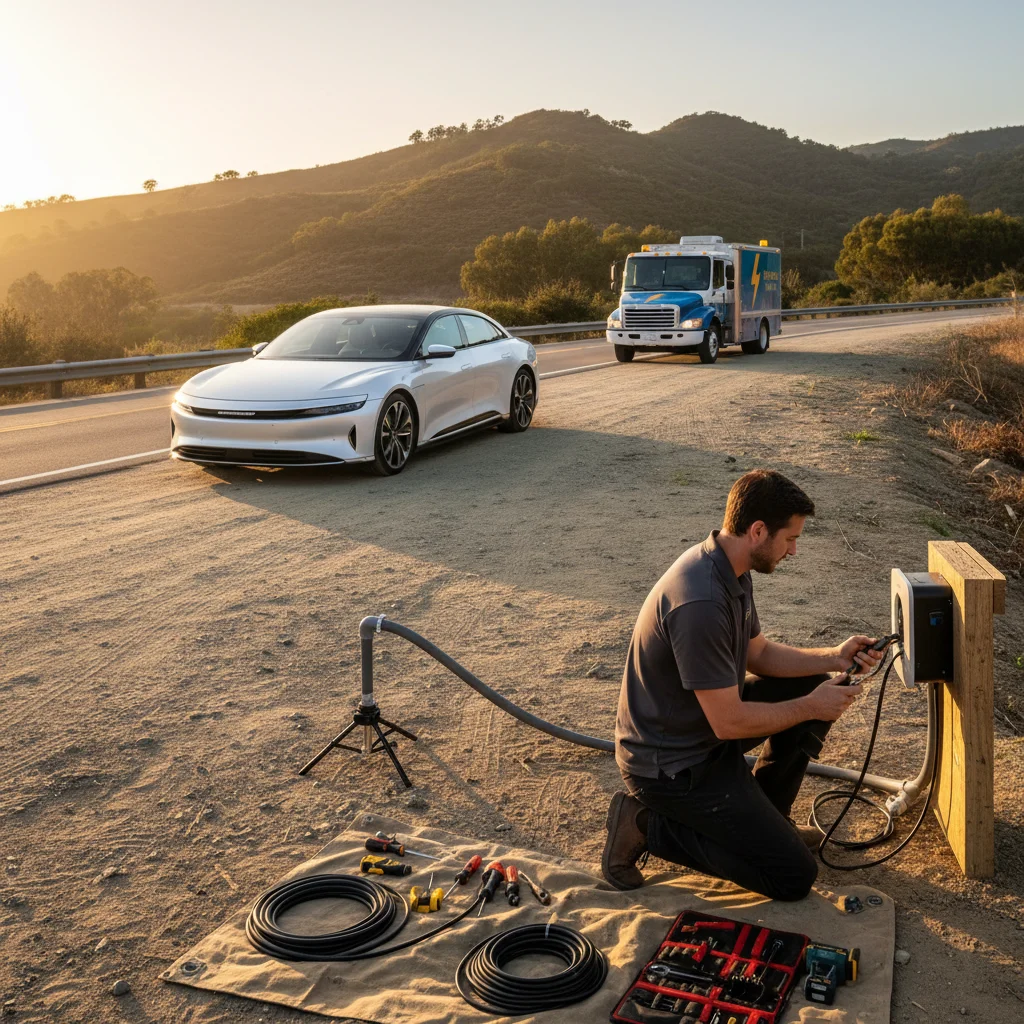
Why Carmel Valley has one of the highest EV densities in the county
If you live in the 92130, you know. Teslas, Rivians, and Lucids are as common as palm trees. Carmel Valley isn’t just an early adopter community; it’s a hub of electric vehicle saturation. Several factors contribute to this, creating a unique environment for EV ownership and, occasionally, the need for roadside help.
First, the community’s demographics align perfectly with the EV market. A high concentration of residents in the tech and biotech sectors means a population that’s comfortable with new technology and has the disposable income for premium electric vehicles. Add to that a strong sense of environmental consciousness, and you have a recipe for massive EV adoption. According to the California Energy Commission, San Diego County is a leading market, and neighborhoods like Carmel Valley are driving that trend.
Second, the housing landscape is ideal for EV ownership. The area is dominated by single-family homes with attached garages, making Level 2 home charging simple and accessible. Most drivers start every day with a full “tank.” But this convenience can sometimes lead to a bit of complacency. A busy week, a forgotten plug-in, or an unexpectedly long trip can disrupt the routine and leave a driver with less range than they thought.
This high density means that while most EV trips are flawless, the sheer number of electric cars on the road increases the statistical chance of someone needing help. It’s not about poor planning; it’s a numbers game. And when you need a tesla rescue carmel valley service, you need someone who understands the local gridlock and geography.
I-5, SR-56, and Del Mar Heights stranded-EV patterns
Carmel Valley’s location at the intersection of major transportation corridors creates specific high-risk zones for out-of-charge events. We see recurring patterns where drivers misjudge their remaining range due to traffic, terrain, and speed. Knowing these spots can help you avoid getting stuck, but it’s also where we focus our rapid-response efforts.
The I-5 is the most obvious chokepoint. Commute-hour traffic between Del Mar Heights Road and the 56/805 merge can be brutal. While slow-moving traffic is generally efficient for an EV, the constant stop-and-go combined with heavy AC use in the summer can drain a low battery faster than the dashboard predicts. Getting stranded on the shoulder of I-5 is not just inconvenient; it’s dangerous.
Then there’s State Route 56, the Ted Williams Freeway. This is a primary east-west route for North City. The long, steady inclines heading east from I-5 toward Pacific Highlands Ranch and Torrey Highlands are notorious battery-killers. A driver might leave the coast with what seems like plenty of range, only to watch it plummet as the car fights gravity. An ev breakdown sr-56 call is one of our most common scenarios in the area.
Del Mar Heights Road itself is the third major trouble spot. It’s a busy surface street with steep grades and multiple traffic lights. The climb from the 5 up to the main residential areas requires significant energy. Drivers trying to make it to a public charger at One Paseo or home to their garage can find themselves a few hundred yards short, often blocking a lane of traffic during peak hours. The traffic and terrain challenges here are similar to what we see just south, making our guide to EV roadside assistance in La Jolla another useful resource for coastal drivers.
One Paseo, the high school, and the school-run squeeze
Beyond the major freeways, Carmel Valley’s internal traffic patterns create unique pinch points where an EV battery can give out at the worst possible moment. These hyper-local scenarios are often more about logistics and timing than long-distance travel.
The shopping centers—One Paseo and Del Mar Highlands Town Center—are magnets for local traffic. They both have public charging stations, which can be a lifesaver. However, they can also be a false hope. During peak hours, these stations are often fully occupied, and a driver running on fumes might arrive to find no available plug. Getting stranded in a packed parking garage while searching for a spot is a frustrating experience we see all too often.
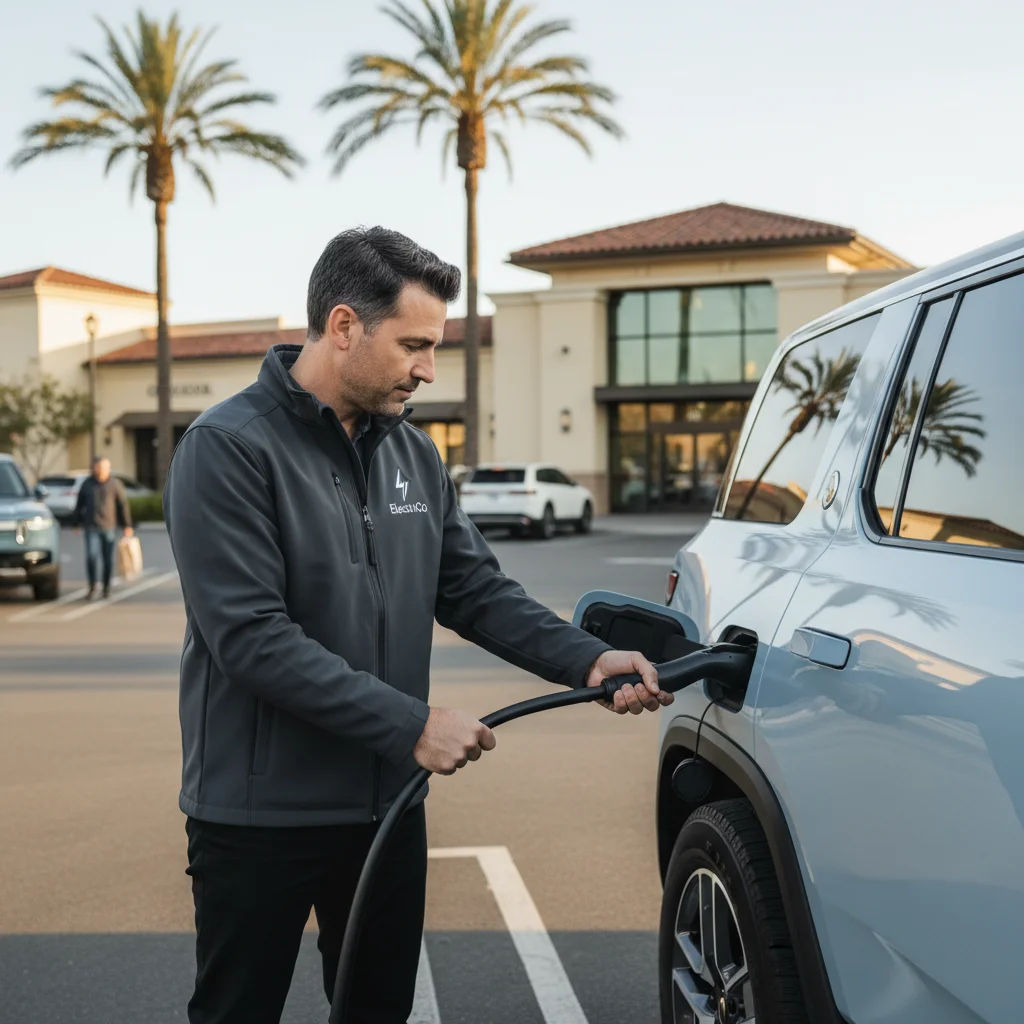
Then there’s the “school-run squeeze.” Torrey Pines High School, Canyon Crest Academy, and the numerous middle and elementary schools create traffic jams every afternoon. Sitting in a pickup line for 20-30 minutes with the climate control running to keep the kids comfortable can consume the last critical miles of range. We’ve rescued parents who ran out of power right in the middle of the pickup loop, a uniquely stressful situation.
Finally, the newer developments like Pacific Highlands Ranch sit at a higher elevation. The final leg of the journey home often involves a sustained uphill climb from SR-56. After a long day of driving, a battery that seemed sufficient can be depleted by this last ascent. It’s a classic case of underestimating the energy required for the final mile, leaving a driver stranded just shy of their own driveway.
What we bring and how fast we arrive from coastal staging
When you’re stuck on the side of the road, speed and capability are all that matter. Our entire emergency EV roadside assistance operation is built around getting to you quickly and providing a real solution on the spot. Because our team is staged to serve the coastal North County communities, we can reach most locations in Carmel Valley much faster than a service dispatched from a central San Diego location.
For calls along I-5, SR-56, or major streets like Del Mar Heights Road, our goal is to arrive in 30-45 minutes. We understand the stress and danger of being stranded on a busy road, and we prioritize these calls. Our rescue vehicles, including our custom-outfitted Cybertrucks, are equipped with powerful mobile chargers capable of delivering a significant boost of energy in a short amount of time.
We don’t just bring a simple portable battery. We arrive with a Level 2 charging system that can add 20-25 miles of range in about an hour. This is more than enough to get you safely off the highway and home, or to a nearby DC fast charging station like the Electrify America at Del Mar Highlands Town Center for a full recharge. Our technicians are trained to work with all major EV brands, from Tesla and Rivian to Ford and Hyundai, ensuring a safe and efficient connection every time. We carry all the necessary adapters (NACS, CCS, J1772) to handle any vehicle you’re driving.
Mobile charge vs tow for North City drivers
If your EV runs out of battery, your first thought might be to call for a tow truck. For years, that was the only option. But for EV drivers in Carmel Valley, a mobile charge is almost always the better choice. It’s faster, more convenient, and often less expensive than a tow.
The biggest issue with towing an EV is the need for a flatbed tow truck. All-wheel-drive EVs, which includes most Teslas and Rivians, cannot be towed with their wheels on the ground without risking serious damage to the motors. This means you can’t just get any tow truck; you need a specific type, and that can lead to much longer wait times. When you’re on the shoulder of SR-56, every minute counts.
Our service for mobile ev charging carmel valley bypasses this entire problem. Instead of moving your car, we bring the energy to you. In the time it might take for the right flatbed to even be dispatched, our technician can be on-site, charging your vehicle. This dramatically reduces your downtime and stress. You’ll be back on your way to your original destination, not to a service center or a distant charging station you didn’t plan to visit.
This on-the-spot solution is why a dedicated mobile EV charging service is so critical in high-density areas. The logic holds true for the entire coastal corridor; as we’ve noted for drivers needing EV roadside assistance in Del Mar, avoiding a tow saves time and protects your vehicle. A direct charge is simply the most efficient way to solve an out-of-charge problem.
When to call Charge Pro
If your EV is dead on the side of the road, your 12V battery has failed, or you’re in a range emergency and won’t make it to a charger, we can help. Our mobile rescue team is equipped to handle any out-of-charge scenario in Carmel Valley and the surrounding areas.
Call us at (858) 808-6055 — we’ll roll a Cybertruck rescue truck to you.