TL;DR
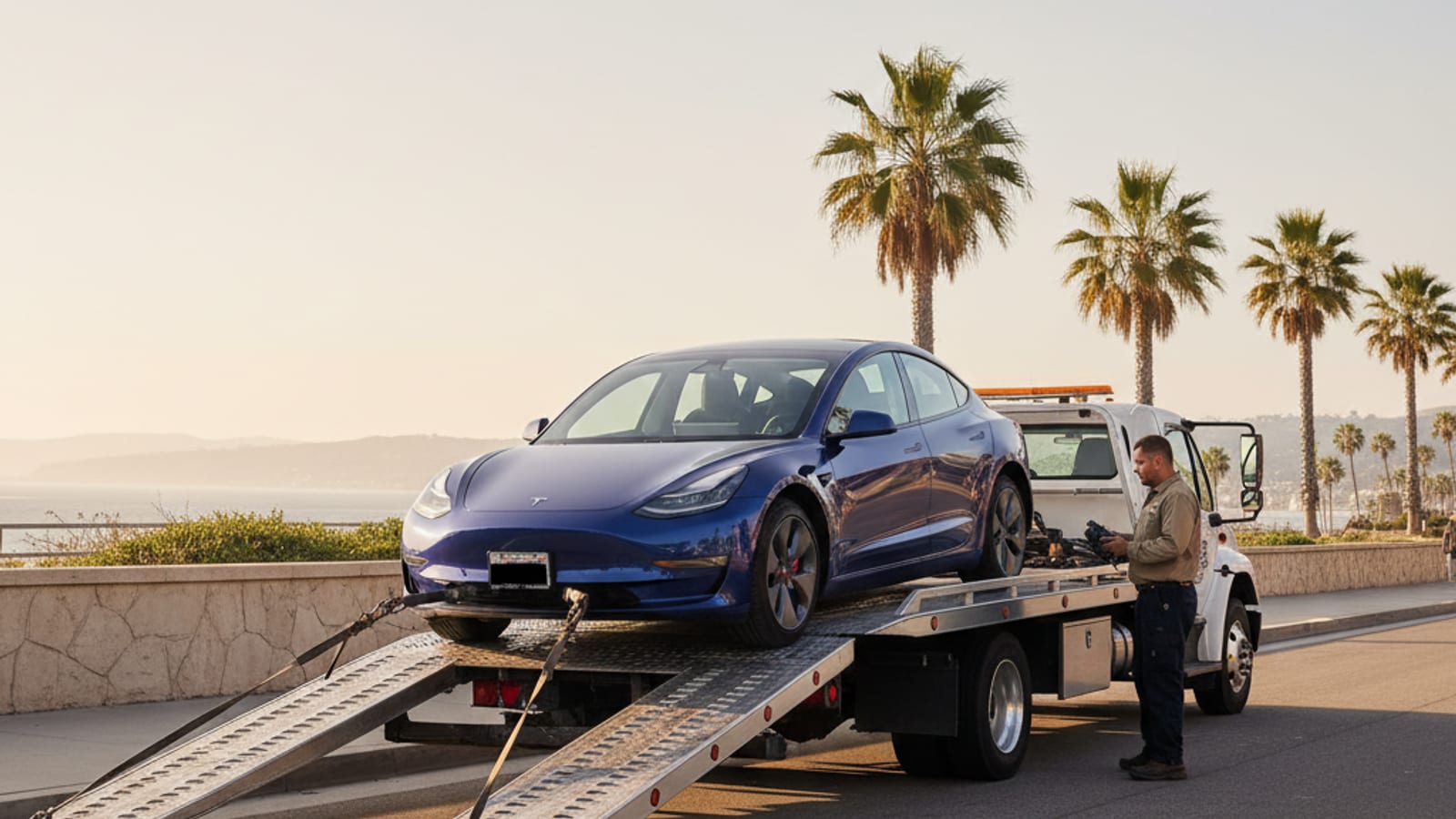
- AAA responds to dead EVs with a flatbed tow — they generally don’t carry on-site charging equipment. You’re towed to a charging station or dealership, then wait to charge. Total time: 2–6 hours.
- Mobile EV charging dispatches a van with portable DC or Level 2 charging. You get 30–60 miles of range on-site in 15–30 minutes. Total time: 45–90 minutes including arrival.
- AAA Plus costs $115/year with 100-mile tow coverage. Mobile EV charging costs $149 per dispatch with no membership required.
- For EV-specific emergencies (dead high-voltage battery, charge port stuck, 12V battery failure), mobile EV charging handles the root cause. AAA handles the symptom (moving the car).
Every EV owner eventually faces a dead battery situation — whether from miscalculating range, a failed charge session, or a 12V battery that died overnight. The question is: do you call AAA or a mobile EV charging service? Here’s what actually happens with each option.
What does AAA do when your EV runs out of charge?
AAA dispatches a flatbed tow truck. That’s it. Here’s the sequence:
- You call AAA and report a dead EV
- They dispatch a flatbed (EVs must be flatbed-towed — wheel-lift towing damages the drivetrain)
- The truck arrives in 30–90 minutes depending on location and demand
- Your EV is loaded and towed to the nearest charging station or dealership
- You ride along or arrange separate transportation
- At the charging station, you plug in and wait 30–60 minutes for enough charge to drive home
Total time from call to driving: 2–6 hours.
AAA does not carry portable EV charging equipment on their trucks. Some regions are piloting EV charging vans, but as of 2026, standard AAA service in San Diego means a flatbed tow — not a charge.
What does mobile EV charging do?
A mobile EV charging service dispatches a van equipped with portable charging equipment directly to your location:
- You call or text, report your location and vehicle
- A charging van arrives in 25–60 minutes (San Diego County coverage)
- The technician plugs in and delivers 30–60 miles of range in 15–30 minutes
- You drive away under your own power
Total time from call to driving: 45–90 minutes.
No tow truck, no ride to a charging station, no waiting at a public charger. You’re back on the road from wherever you stopped — freeway shoulder, parking garage, driveway.
How do the costs compare?
| AAA Plus | AAA Premier | Mobile EV charging | |
|---|---|---|---|
| Annual membership | $115/year | $175/year | None required |
| Per-incident cost | $0 (within limits) | $0 (within limits) | $149 dispatch |
| Tow coverage | Up to 100 miles | Up to 200 miles | No tow needed |
| EV charging on-site | No | No | Yes (30–60 miles delivered) |
| 12V battery jump | Yes | Yes | Yes |
| Stuck charge port | No | No | Yes |
| Time to driving | 2–6 hours | 2–6 hours | 45–90 minutes |
| After-hours availability | Yes (24/7) | Yes (24/7) | Yes (24/7, +$50 after-hours) |
The math: If you use roadside assistance once per year, AAA Plus ($115) is cheaper than a single mobile charging dispatch ($149). But AAA gives you a tow, not a charge — so you’re still paying for public charging at the station, plus 2–4 hours of your time. If your time has any value at all, the $34 difference evaporates.
If you use roadside assistance zero times per year (most drivers), AAA is $115 for nothing. Mobile EV charging is $0 until you need it.
When is AAA the better option?
AAA makes more sense when:
- Your EV has a mechanical problem (not just a dead battery) — suspension failure, flat tire on a rim that can’t take a spare, collision damage. You need a tow regardless.
- You’re outside mobile charging coverage area — remote areas of East County or mountain roads where mobile charging vans don’t dispatch.
- You need the EV moved to a specific shop — warranty work at a dealership, specialized repair at a body shop. AAA gets the car there.
- You already have AAA for your ICE vehicles — the membership covers all your cars. Adding EV roadside is marginal cost.
When is mobile EV charging the better option?
Mobile EV charging makes more sense when:
- You’re out of charge on the freeway — you need range, not a tow. A charge van gets you 30–60 miles and sends you on your way.
- Your 12V battery died — Tesla’s 12V battery failure is a known issue. Mobile EV technicians carry replacement 12V batteries ($220–$380 installed on-site) and can diagnose whether the 12V or the high-voltage system is the problem.
- Your charge port is stuck — AAA can’t fix a stuck charge port. A mobile EV tech can.
- You’re in a parking garage or tight space — flatbed tow trucks can’t always access parking structures. A charging van can.
- Time matters — job interview, flight to catch, kids to pick up. The 2–6 hour AAA timeline doesn’t work.
Does Tesla roadside assistance replace both?
Tesla roadside assistance is included for 4 years on new Teslas. It covers towing to a Tesla service center, tire changes, lockouts, and some 12V jump starts. What it generally doesn’t cover:
- On-site mobile charging (they tow to a Supercharger)
- Non-warranty 12V battery replacement
- Charge port mechanical repair
- Vehicles outside the 4-year/50,000-mile warranty window
After year 4, you’re either paying per-incident or relying on AAA. Mobile EV charging fills the gap for charge-specific emergencies that neither Tesla nor AAA handles on-site.
Can you use both?
Yes — and for EV owners who drive frequently, this is the practical answer. Keep AAA for general roadside (flats, lockouts, collision tows) and know that mobile EV charging exists for charge-specific emergencies where a tow doesn’t solve the problem.
The two services aren’t competitors. They solve different problems. AAA moves a broken car. Mobile EV charging fixes a charge problem on the spot.
The bottom line
If your EV’s battery is dead and the car is otherwise fine, a tow is the wrong tool. You don’t tow a gas car to a gas station — you bring gas to the car. Mobile EV charging is the same logic applied to electric vehicles.
Frequently asked questions
Does AAA charge dead EVs on-site?
As of 2026, standard AAA service in San Diego does not include on-site EV charging. AAA dispatches a flatbed tow truck and takes your EV to the nearest charging station or dealership. Some AAA regions are piloting EV charging vans, but this is not widely available in Southern California yet.
How much does mobile EV charging cost compared to AAA?
AAA Plus costs $115/year as a membership fee with unlimited qualifying calls. Mobile EV charging has no membership — each dispatch costs $149 with $1.80 per added mile beyond the service area. AAA is cheaper per-incident if you use it, but AAA gives you a tow (2–6 hours), not a charge (45–90 minutes).
Can a mobile charging van charge any EV brand?
Yes. Mobile charging services carry adapters for Tesla, Rivian, Ford, Chevy, BMW, Hyundai, Kia, and all other major EV brands. The charging van delivers 30–60 miles of range regardless of make or model. Charge port connector type (CCS, NACS, J1772) doesn’t matter — the van carries all three.
What should I do if my EV dies on the freeway in San Diego?
Pull to the right shoulder or nearest safe area, turn on hazard lights, and stay in the vehicle if possible. Call a mobile EV charging service — a charging van arrives in 25–60 minutes and delivers enough range to reach the nearest Supercharger or Level 2 station. See our full freeway breakdown guide for step-by-step instructions.
We dispatch across all of San Diego County — Downtown, La Jolla, Chula Vista, Oceanside, and Escondido. Call (858) 808-6055 for immediate dispatch.